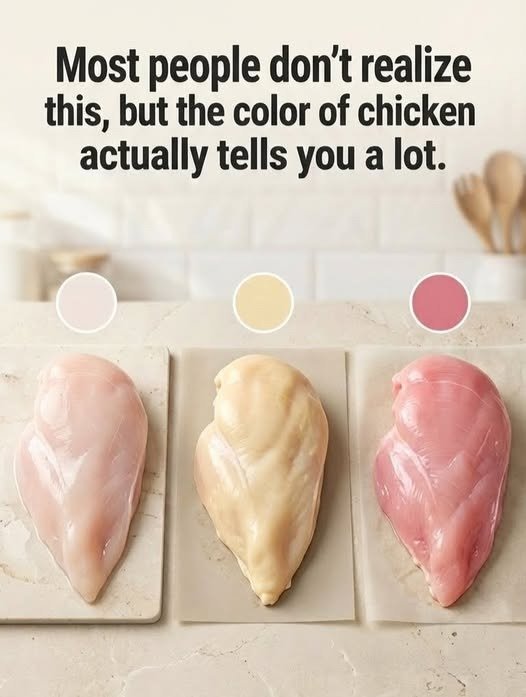
In many grocery stores, two packs of chicken breast can sit side by side — one pale and pink, the other slightly yellow — and quietly trigger very different reactions.
Some shoppers reach automatically for the lighter meat, assuming it looks “cleaner.” Others prefer the yellow tint, believing it signals richer flavor or better nutrition. Few pause to question where these ideas came from.
Yet the truth is far less simple.
The color of chicken meat tells a story, but not the one most people think it does.
What Chicken Color Actually Reflects
The shade of chicken meat is shaped long before it reaches a supermarket shelf.
It is influenced by:
- The bird’s diet
- Its breed
- Farming conditions
- Processing methods
- Storage and lighting
Feed rich in corn or plant pigments can create a yellowish tone. Grain-heavy diets may produce paler meat. Certain breeds naturally develop different coloring.
None of this automatically signals better or worse quality.
Color is largely a reflection of how the animal was raised — not how nutritious or safe it is.
Why “Yellow Means Better” Became a Popular Belief
In some regions, yellow chicken became associated with traditional farming.
Free-range birds and home-raised poultry were often fed natural grains and plants that deepened skin and fat color. Over time, this created a cultural belief that yellow meant “authentic” or “healthier.”
Industrial producers noticed this preference and adapted.
Some began adjusting feed formulas to create a similar appearance, even in large-scale operations. Marketing followed, reinforcing the idea that color equaled quality.
The association became habit — not science.
The Role of Diet and Pigments
Certain plant compounds, called carotenoids, influence meat and skin color.
These compounds are found in:
- Corn
- Alfalfa
- Marigold extracts
- Some grasses
When chickens consume them, pigments accumulate in fat and skin, altering appearance.
This process affects color far more than it affects nutrition.
A yellowish hue may look appealing, but it does not automatically mean higher protein, better vitamins, or safer meat.
Processing and Storage Change Appearance
What happens after slaughter matters too.
During processing, chilling, packaging, and exposure to oxygen all influence how chicken looks.
For example:
- Oxygen exposure can lighten meat
- Cold storage can dull color
- Packaging materials affect visual tone
- Store lighting alters perception
By the time a shopper sees the product, its color has already been shaped by multiple artificial factors.
The display does not represent a “natural” state.
Why Pale Chicken Isn’t Inferior
Many consumers avoid paler chicken, assuming it is bland or low-quality.
In reality, pale meat often comes from birds fed grain-based diets common in regulated farming systems. These systems prioritize disease control, consistency, and food safety.
Such meat can be:
- Nutritionally balanced
- Carefully inspected
- Properly handled
- Free from contaminants
Appearance alone does not indicate inferior standards.
It simply reflects a different production model.
Safety Is Determined Elsewhere
Food safety does not come from color.
It comes from:
- Veterinary oversight
- Sanitation procedures
- Temperature control
- Handling practices
- Regulatory inspection
A yellow chicken handled improperly is riskier than a pale one processed correctly.
Yet shoppers rarely see these invisible systems.
They judge what is visible.
How Marketing Shapes Consumer Perception
Packaging often reinforces visual bias.
Words like “farm-raised,” “traditional,” or “natural” are paired with imagery that highlights color. Photos are edited to emphasize warm tones. Labels are designed to suggest authenticity.
Over time, shoppers learn to associate certain shades with trust.
This conditioning happens slowly — and powerfully.
Most people never realize they’ve been trained to judge food this way.
The Cost of Appearance-Based Choices
When consumers rely on color, they overlook more meaningful information.
They ignore:
- Farming transparency
- Animal welfare standards
- Antibiotic policies
- Environmental impact
- Supply chain ethics
Visual cues become shortcuts.
Convenient, but incomplete.
This limits informed decision-making and rewards surface-level marketing.
How to Evaluate Chicken More Reliably
Instead of focusing on color, experts suggest looking at:
- Source information
- Certification labels
- Expiration dates
- Packaging integrity
- Storage conditions
Texture and smell after opening are also more reliable indicators than appearance in-store.
Quality is contextual, not visual.
A Broader Lesson About Food Perception
The confusion around chicken color reflects a wider issue.
Modern food systems are complex. Production happens far from consumers. Marketing fills the gap with simplified signals.
Color becomes a symbol.
But symbols are rarely accurate.
Learning to question these cues helps people navigate food choices more intelligently — and with less anxiety.
Understanding What You’re Really Seeing
A piece of chicken in a plastic tray carries the story of genetics, farming, transport, storage, and retail design.
Its color is just one small chapter.
It does not predict safety.
It does not guarantee nutrition.
It does not define quality.
It simply reflects a process.
And understanding that process allows shoppers to move beyond appearance — toward choices based on knowledge, not assumption.