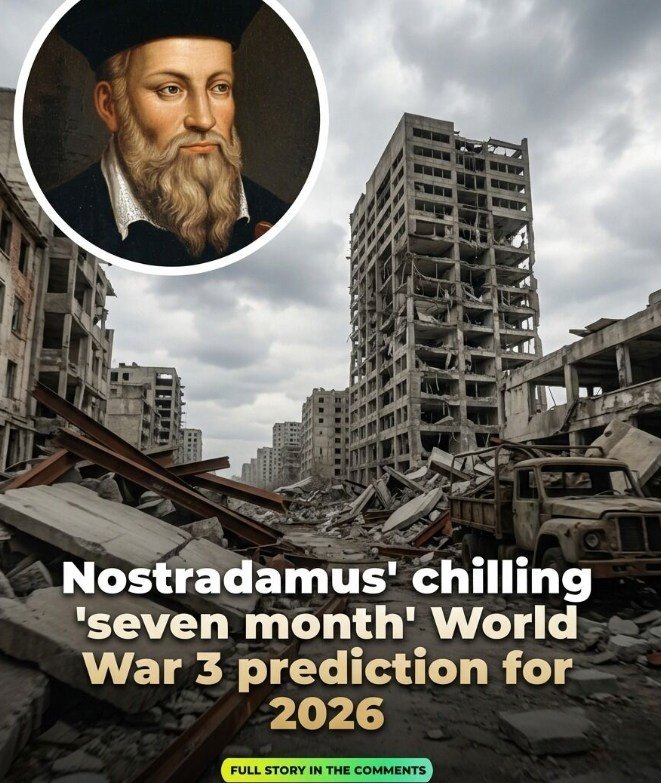
Across centuries, few historical figures have captured the imagination quite like Nostradamus. His short, cryptic poems—written more than 450 years ago—continue to resurface whenever the world feels uncertain. And lately, one particular line has found its way back into headlines and social media discussions.
It speaks of a war lasting seven months.
For some readers, the verse sounds uncannily relevant. With rising geopolitical tensions and ongoing conflicts dominating global news, many people have begun revisiting Nostradamus’ writings, wondering whether the Renaissance astrologer might have anticipated something about our present moment.
But like many of his prophecies, the meaning of the passage is far from straightforward.
A Line That Refuses to Fade
The phrase most often quoted comes from one of Nostradamus’ famous quatrains—four-line poems published in his 1555 book Les Prophéties. In translation, the line reads roughly:
“Seven months great war, people dead through evil.”
The verse goes on to mention the French cities of Rouen and Évreux, adding another layer of mystery. Over the years, interpreters have repeatedly attempted to match these words with real-world conflicts or disasters.
Whenever global tensions rise, interest in this passage tends to surge again.
Today is no different.
As conflicts and political rivalries intensify in several regions, discussions about Nostradamus’ supposed predictions have returned to public conversation—especially online, where speculation can spread quickly.
The Man Behind the Prophecies
Michel de Nostredame, known to history as Nostradamus, was a 16th-century French physician, astrologer, and writer. He lived during a time when astrology and predictions about the future were widely accepted forms of scholarship.
In 1555, he published Les Prophéties, a collection of hundreds of short poems describing wars, disasters, and political upheaval.
These quatrains were intentionally obscure. Nostradamus mixed languages, metaphors, and historical references, creating verses that could be interpreted in many different ways.
That ambiguity may be the reason his work has remained relevant for centuries. Each generation finds new meaning in the same lines.
Why People Link It to Modern Conflicts
The idea that a “seven-month war” could describe a modern global conflict has captured attention in recent weeks.
Some commentators suggest the prophecy might symbolize a short but intense war involving multiple powers. Others speculate that the imagery could refer to technological warfare—perhaps drones or missile strikes occurring over several months.
Still others believe the prophecy hints at geopolitical shifts rather than a literal global war.
But historians caution against reading the verse too literally.
The cities mentioned in the quatrain—Rouen and Évreux—are located in France, which suggests the poem may have originally referred to regional conflicts or political tensions of Nostradamus’ own era.
The prophecy itself contains no reference to the year 2026, or any other specific time period.
How Nostradamus Became a “Prophet”
Part of Nostradamus’ enduring reputation comes from the belief that he predicted major historical events.
Over the centuries, supporters have claimed his writings anticipated everything from the French Revolution to the rise of world leaders and even modern wars.
However, many scholars argue that these connections are made only after events occur.
Because the quatrains are vague and symbolic, they can often be interpreted in ways that seem to match later events—a phenomenon sometimes described as “retroactive prophecy.”
In other words, people often find patterns in the text once they already know what happened.
The Role of Social Media in Reviving Old Predictions
In the modern era, Nostradamus’ verses spread faster than ever.
A single post, video, or headline can spark a wave of speculation across platforms. When global news feels uncertain, audiences often turn to historical predictions for clues or reassurance.
Search trends frequently spike whenever a prophecy appears to align with current events. Recent discussions about the “seven-month war” are a good example of how quickly these ideas can circulate online.
But the viral nature of such claims doesn’t necessarily make them accurate.
Why Prophecies Feel Convincing
There is a reason Nostradamus’ words continue to fascinate readers centuries later.
His writing style relies heavily on symbols and poetic imagery—burning skies, rising powers, mysterious adversaries. These descriptions can easily be connected to modern technologies or political conflicts.
For instance, references to “fire from the sky” have been interpreted as missiles or air strikes, even though similar imagery was common in Renaissance astrology and literature.
Because the language is flexible, readers often see what they expect—or fear—to see.
Between History and Speculation
The fascination with Nostradamus ultimately reveals as much about modern society as it does about the past.
Periods of uncertainty tend to revive interest in predictions and prophecies. When people feel that history is moving quickly or unpredictably, they often look for signs that someone, somewhere, might have seen it coming.
Yet historians generally agree that Nostradamus’ writings were never meant to function as a precise roadmap of the future.
They were poetic reflections shaped by the fears and political realities of the 16th century.
A Mystery That Endures
More than four centuries after his death, Nostradamus remains one of the most discussed figures in the history of prophecy.
Whether his quatrains are viewed as mystical insight, historical curiosity, or simply clever poetry, they continue to inspire debate.
And as long as the world faces uncertainty, those brief and enigmatic lines will likely keep resurfacing—inviting each new generation to interpret them in its own way.