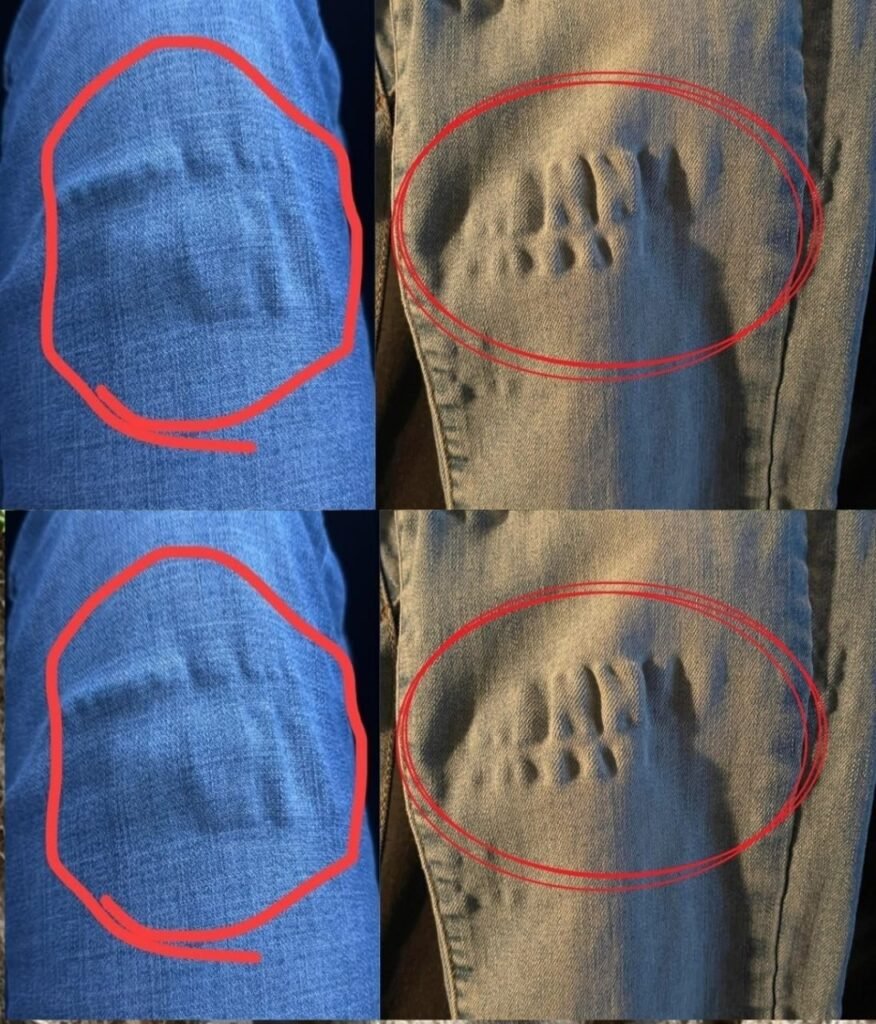
You pull your jeans out of the dryer expecting the familiar: soft denim, clean seams, a shape you know by heart. Instead, you notice it immediately—odd ripples along the legs, twisted seams, fabric that looks slightly warped no matter how you smooth it out.
They weren’t there before the wash.
And now you can’t unsee them.
This isn’t a sign your jeans are ruined. It’s a quiet side effect of how denim is made, how it reacts to water and heat, and how modern washing habits interact with fabric that was never meant to stay perfectly still.
Denim Is Under Tension Before You Ever Buy It
Most people think of denim as sturdy and unchanging. In reality, it’s under constant tension from the moment it’s woven.
During manufacturing:
- Denim fabric is stretched tightly on looms
- Threads are held under stress to create durability
- The material is cut and sewn while still under tension
That tension doesn’t disappear when the jeans leave the factory. It stays locked in—until water and heat give the fibers permission to relax.
Washing is often the first time denim gets that permission.
Water Is the Trigger That Starts the Shift
When denim gets wet, the cotton fibers swell. This changes their length and alignment, even if only slightly.
As the fabric absorbs water:
- Some fibers relax more than others
- Areas with seams resist movement
- Flat sections shift unevenly
The result isn’t shrinkage in the traditional sense—it’s redistribution. Fabric moves, but not uniformly.
That uneven movement is what creates ripples.
Seams Are the Biggest Culprits
If the ripples seem to follow seams, that’s not your imagination.
Seams are reinforced. They’re stitched tightly and resist the same level of relaxation as the surrounding fabric. When the rest of the denim shifts but the seam doesn’t, the fabric nearby has nowhere to go.
So it bunches.
And that bunching becomes visible waves.
This is especially common along:
- Outer leg seams
- Inner thigh seams
- Areas around the knees
Places where stress and movement already exist get exaggerated.
Heat Locks the Ripples In
The dryer doesn’t create the problem—but it finishes it.
Heat causes fibers to set in their new position. If denim dries while twisted, folded, or compressed, the ripples become more defined.
That’s why jeans that look only slightly uneven when wet can look dramatically rippled once dry.
The fabric has essentially “memorized” the shape it dried in.
Why Some Jeans Ripple More Than Others
Not all denim behaves the same.
Jeans are more prone to rippling if they:
- Use lower-quality or loosely spun cotton
- Have stretch fibers blended in
- Are heavily stone-washed or pre-distressed
- Are tightly fitted in high-movement areas
Stretch denim, in particular, reacts unpredictably. The elastic fibers and cotton fibers don’t shrink or relax at the same rate, creating tension that shows up as ripples.
Why Ironing Doesn’t Always Fix It
Many people try to iron the ripples out—sometimes with limited success.
Ironing can temporarily smooth the surface, but it doesn’t reset the internal fiber structure. Once the jeans are worn again, body heat and movement often bring the ripples right back.
The issue isn’t surface-level. It’s structural.
Washing Habits That Make Ripples Worse
Certain habits amplify the effect:
- Overloading the washer
- Using high-spin cycles
- Washing in hot water
- Drying on high heat
All of these increase twisting, tension, and uneven drying.
Jeans don’t like chaos in the wash. And modern machines are very good at creating it.
Why This Isn’t a Defect
Rippling feels like something went wrong—but in most cases, it’s simply denim behaving as designed.
Jeans are meant to move, age, and adapt. The same properties that make them comfortable and durable also make them responsive to washing conditions.
Perfectly flat denim is usually a sign of heavy chemical processing—not fabric health.
How People Quietly Reduce Rippling
Those who want to minimize the effect often:
- Wash jeans inside out
- Use cold water
- Choose gentler cycles
- Hang-dry or lay flat instead of machine drying
These steps don’t eliminate ripples entirely—but they reduce how dramatically fibers shift and set.
The Calm Takeaway
Those strange ripples aren’t damage. They’re denim revealing how it responds to water, heat, and movement.
Jeans aren’t static objects. They’re fabrics under memory—constantly adjusting to how they’re treated.
Once you understand that, the ripples stop feeling like a flaw and start looking like what they really are: evidence that the fabric is alive, flexible, and doing exactly what it was made to do.