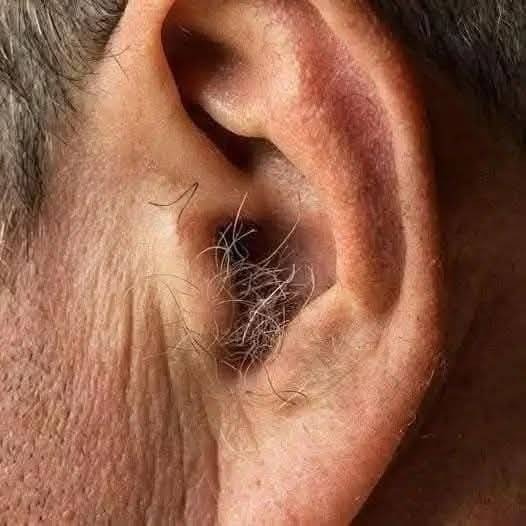
He noticed it in the mirror one morning while brushing his teeth.
A thin, pale strand, barely visible unless the light hit it just right. It hadn’t been there before. Or maybe it had, and he’d simply never paid attention. Either way, it lingered in his thoughts longer than he expected.
Was this normal? Was something wrong?
For many people, especially after midlife, ear hair appears suddenly and quietly, raising unnecessary concern. Yet behind this small change lies a simple biological story — one rooted in time, hormones, and genetics rather than illness.
How Aging Changes Hair Growth Patterns
The human body does not age evenly.
Some systems slow down early. Others change gradually. Hair follicles are among the most sensitive to these shifts.
As people grow older, follicles in certain areas become more responsive to hormonal signals. While scalp hair may thin, hair in places like the ears, nose, and eyebrows often becomes more active.
This contrast feels strange, but it follows a predictable pattern.
The Influence of Hormones Over Time
Hormones guide hair behavior throughout life.
Androgens such as testosterone and its byproducts affect different follicles in different ways. Over decades, the body’s hormonal balance shifts, and sensitivity increases in specific tissues.
This is why many older adults notice:
- Thicker eyebrows
- Longer nose hair
- Increased ear hair
It is not a sign of excess hormones. It is a sign of changing responsiveness.
Both men and women experience this, though it is more visible in men due to lifelong androgen exposure.
Genetics Set the Framework
Family history plays a major role.
If close relatives developed noticeable ear hair later in life, chances are high that the same pattern will appear in future generations.
Genes determine:
- Where follicles are located
- How strongly they respond to hormones
- How long growth cycles last
- Hair thickness and texture
No lifestyle habit can override this blueprint.
The Forgotten Purpose of Ear Hair
From a biological perspective, ear hair serves a protective role.
It helps block dust, insects, and small particles from entering the ear canal. In youth, this hair is usually fine and unobtrusive. With age, growth cycles lengthen, allowing strands to become more visible.
What once worked quietly in the background becomes noticeable.
This is adaptation, not malfunction.
Separating Fact From Common Myths
Misunderstanding has created persistent myths.
Some believe ear hair indicates circulation problems. Others associate it with organ disease or hormonal disorders. These claims lack medical evidence.
Another common fear is that trimming makes hair grow thicker. In reality, trimming only changes how hair feels at the tip.
None of these beliefs reflect biological reality.
The Emotional Side of Visible Aging
Small physical changes often carry emotional weight.
Society frequently equates aging with decline, encouraging people to view normal changes as flaws. Ear hair becomes a symbol of “getting older,” even though it has no bearing on health or ability.
This mindset creates unnecessary embarrassment.
Aging is not deterioration. It is progression.
Grooming as Personal Choice
Some people prefer to trim ear hair. Others do not.
Both approaches are valid.
Safe methods include electric trimmers and rounded scissors. Risky methods — such as deep plucking or waxing — can irritate sensitive skin and increase infection risk.
Grooming should be guided by comfort, not anxiety.
When Hair Growth Deserves Attention
In rare cases, sudden excessive hair growth across the body may relate to medication side effects or medical conditions.
Gradual ear hair development over decades, however, is not concerning.
Context matters.
Sudden changes deserve evaluation. Slow, age-related shifts usually do not.
What Ear Hair Really Represents
Ear hair reflects time.
It reflects hormonal history.
Genetic inheritance.
Biological adaptation.
It does not reflect illness.
It does not reflect failure.
It does not reflect loss of worth.
It reflects a body that has lived.
A Quiet Marker of Human Longevity
Every wrinkle, gray strand, and subtle change tells part of a story.
Ear hair is one small detail in that narrative — evidence of resilience, adjustment, and continuity.
Understanding it replaces fear with clarity.
And clarity, in matters of health, is always more valuable than worry.