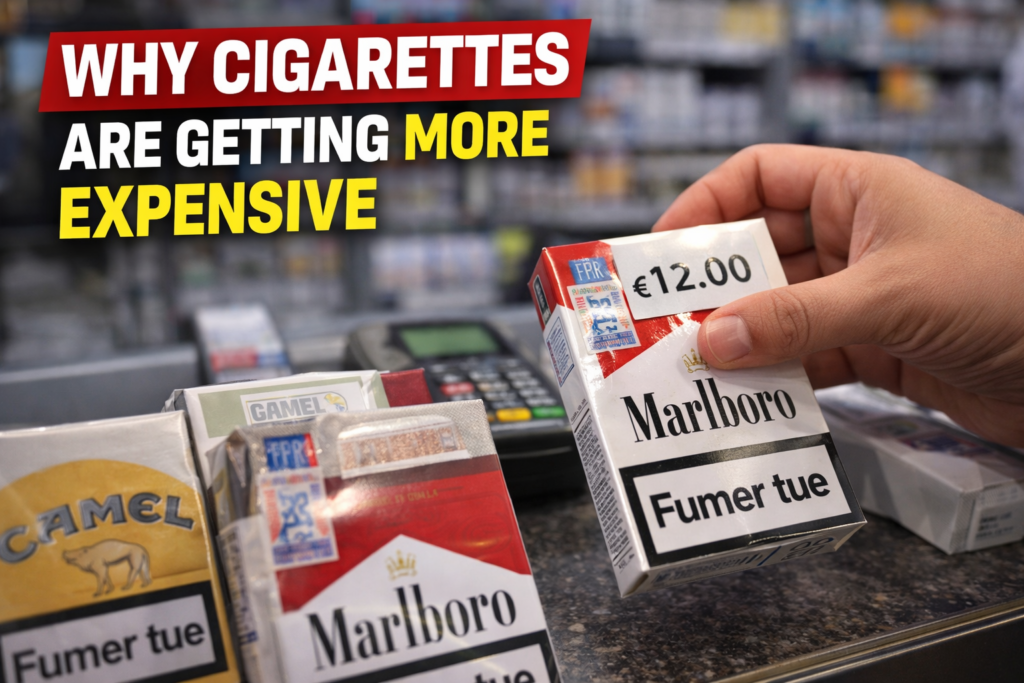
For many smokers, the moment of paying at the counter often brings the same quiet surprise: the price seems higher than last time.
Across many countries, cigarette prices have steadily climbed over the years. What once cost only a few euros or dollars now carries a much heavier price tag. In places like France, a single pack can now exceed €12, a level reached after years of gradual tax increases and policy changes.
But the retail price of a cigarette pack is not simply determined by the tobacco company. Behind that number lies a complex mix of taxes, distribution costs, and margins shared among several actors.
Understanding how that price is built reveals why cigarettes have become one of the most heavily taxed consumer products.
The Largest Portion: Government Taxes
The biggest share of the price paid for cigarettes goes to the government.
In many European countries, including France, taxes represent the majority of the retail cost. For example, official data shows that when a pack sells for about €11.50, more than €9.50 of that price may consist of taxes and duties collected by the state.
These taxes typically include several components:
- Excise taxes specifically applied to tobacco products
- Value-added tax (VAT) included in the final retail price
- Minimum tax thresholds set by national regulations
In France, the excise tax alone includes both a percentage of the retail price and a fixed amount per quantity of cigarettes.
The goal of these taxes is not only to generate revenue but also to discourage tobacco consumption by making cigarettes less affordable.
Retailers and Distribution Margins
Although governments collect most of the revenue, part of the price is also shared among businesses that sell the product.
Retail tobacco shops — often called tobacconists — receive a commission for each pack sold. In France, the standard discount given to tobacconists is around 10% of the retail price.
This margin allows retailers to earn income while operating under strict state regulation.
Manufacturers also retain a portion of the price to cover production costs, marketing expenses, and profits. However, compared with the tax share, the manufacturer’s margin is relatively small.
In many cases, less than one euro from the total price of a pack ends up with the tobacco producer.
Why Prices Continue to Rise
Cigarette prices have not increased randomly.
Governments across Europe and other regions have adopted long-term strategies aimed at reducing smoking rates. One of the most widely used methods is raising tobacco taxes.
Public-health organizations often support this approach because research shows that higher prices tend to reduce consumption. Increasing the cost of tobacco products can discourage young people from starting to smoke and encourage current smokers to quit.
As a result, many governments adjust taxes periodically, leading to gradual price increases.
Recent policy changes in France illustrate this trend. Official announcements confirmed that cigarette prices could rise again, sometimes by up to €1 per pack, pushing many brands above €12.50.
The Role of European Regulations
European Union rules also influence cigarette pricing.
The EU requires member states to impose minimum excise duties on tobacco products. These rules ensure that taxes represent at least a significant portion of the retail price across all member states.
However, individual countries are free to set higher taxes than the minimum.
This explains why cigarette prices vary widely across Europe. Some countries maintain relatively lower taxes, while others impose much higher ones to support public-health policies.
For example, Ireland and France are among the countries with the highest tobacco taxes per pack within the EU.
Economic and Social Effects
Rising cigarette prices have several consequences beyond the immediate cost to smokers.
One effect is a gradual decline in tobacco consumption. Studies consistently show that as prices rise, many smokers either reduce their consumption or stop altogether.
However, higher prices can also create economic side effects.
In regions close to national borders, smokers sometimes purchase cigarettes in neighboring countries where taxes are lower. This cross-border shopping can reduce local sales and affect tobacco retailers in higher-tax areas.
Another issue occasionally discussed is the growth of illicit cigarette markets when price differences between countries become too large.
Despite these challenges, most public-health authorities continue to view tobacco taxation as one of the most effective tools for reducing smoking.
A Product Shaped by Policy
Unlike many other consumer goods, the price of cigarettes is strongly influenced by government policy.
While manufacturing costs and retail margins play a role, taxation remains the dominant factor shaping the final price that consumers see at the counter.
Each increase reflects broader decisions about public health, taxation policy, and the long-term effort to reduce smoking rates.
For smokers, the rising price may simply feel like another increase at the register.
But behind that number lies a complex system designed to balance economic interests, government revenue, and the ongoing effort to address the global health impact of tobacco use.