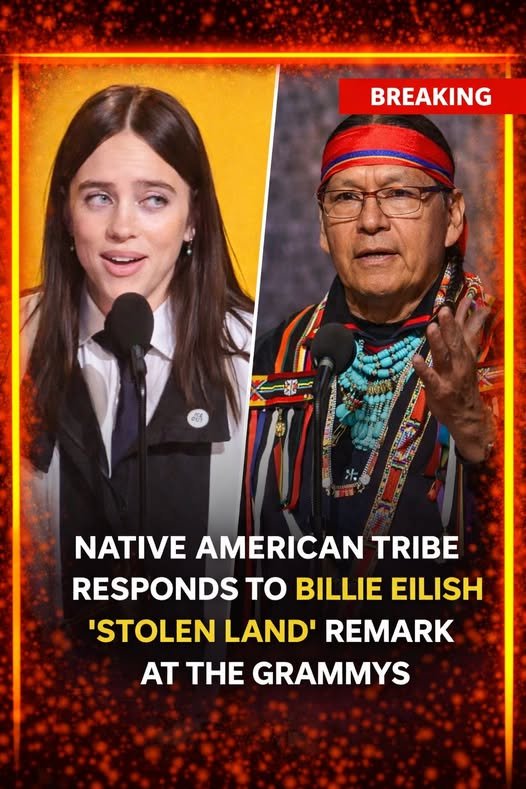
The moment passed quickly on stage. A few remarks, a global broadcast, applause, and then the ceremony moved on. But for one Native American tribe, comments made during the Grammy Awards didn’t fade with the music. They prompted a response—measured, deliberate, and rooted in a much longer history than any awards show could capture.
What followed wasn’t outrage in the viral sense. It was something more revealing: an effort to correct the narrative and explain why casual references can carry real weight.
What Was Said — and Why It Resonated
Billie Eilish’s comments were not framed as an attack. They were brief, informal, and delivered in a setting known for symbolic gestures rather than policy statements. That context matters—but it doesn’t erase impact.
For Indigenous communities, references to identity, culture, or history are rarely isolated moments. They sit atop generations of misrepresentation, oversimplification, and erasure. Even well-intended remarks can reopen familiar tensions when they echo stereotypes or blur distinctions between tribes, traditions, or experiences.
The tribe’s response focused less on assigning blame and more on clarifying why words spoken casually can land heavily.
Why Representation Isn’t Abstract
One of the key points raised was visibility. Native American communities are often discussed rather than heard from. When Indigenous identity appears in mainstream spaces, it is frequently reduced to symbols or generalized language.
The tribe emphasized that visibility without accuracy can be as damaging as invisibility. When public figures speak about Indigenous culture—even indirectly—they influence how millions of people understand it.
This isn’t about policing speech. It’s about recognizing reach.
The Power Gap Behind the Conversation
The response also highlighted an imbalance that often goes unnamed. Celebrities speak from platforms that amplify their words instantly and globally. Indigenous communities, by contrast, must work to be noticed at all.
That imbalance shapes the conversation. A comment that seems fleeting to an artist can become a defining reference point for communities accustomed to being misunderstood.
Acknowledging that gap doesn’t require silence—it requires care.
Why the Tribe Chose Dialogue Over Condemnation
Notably, the response avoided outrage-driven framing. There were no demands for cancellation or public shaming. Instead, the tone centered on education and context.
This approach reflects a broader strategy many Indigenous groups have adopted: correcting narratives rather than escalating conflict. The goal is not to dominate the conversation, but to deepen it.
That choice itself carries significance. It signals confidence in cultural authority rather than defensiveness.
The Broader Pattern at Play
This moment fits into a larger pattern of how Indigenous identity is handled in popular culture. Awards shows, fashion, and music often draw inspiration from marginalized cultures without engaging with the people behind them.
When pushback occurs, it is sometimes dismissed as oversensitivity. But the repetition of these moments suggests something systemic rather than isolated.
The tribe’s response reframed the issue as one of listening rather than intent.
What Responsibility Looks Like Now
The conversation also raises questions about what responsibility looks like for public figures today. It doesn’t mean avoiding all references to culture or history. It means understanding context before speaking—and being open to learning afterward.
When responses like this emerge, they offer an opportunity. Not to retreat, but to engage more thoughtfully.
Silence after correction isn’t growth. Reflection is.
Why This Moment Will Outlast the Headlines
Awards shows fade. Headlines move on. But moments like this accumulate, slowly reshaping expectations around representation and respect.
The tribe’s response wasn’t designed to trend. It was designed to endure—to add clarity where simplification had crept in.
That longevity may be its most important feature.
A Conversation Still Unfolding
This wasn’t a closing statement. It was an invitation—to listen more carefully, to ask better questions, and to recognize that cultural references are never neutral.
When Indigenous communities speak for themselves, the issue isn’t whether they are being too sensitive. It’s whether others are willing to hear what’s being said.
In that sense, the response matters not because of who made the original comment, but because of who chose to answer—and how.