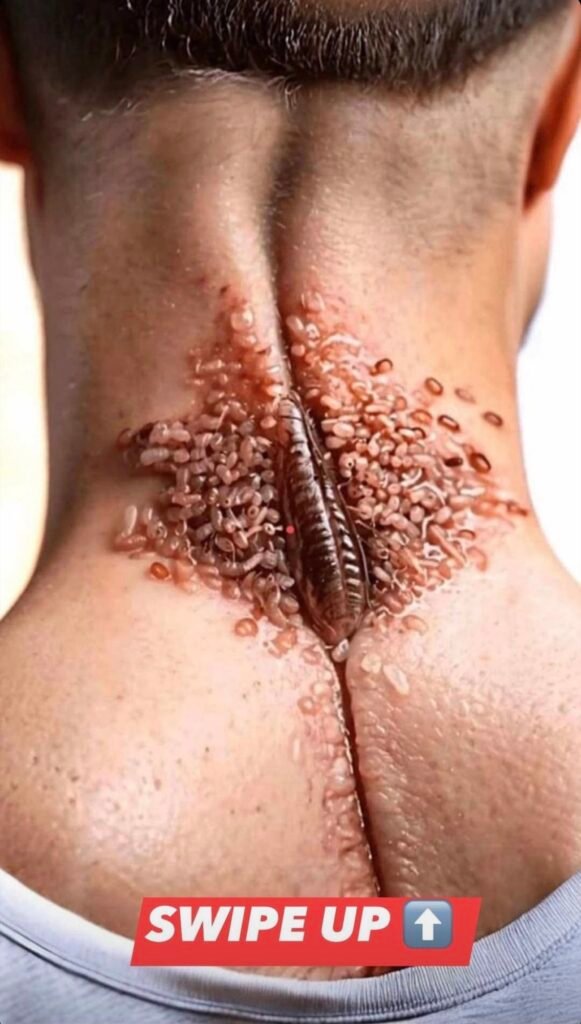
The image appears suddenly, sandwiched between vacation photos and recipe videos. A human neck, viewed from behind. A deep line down the spine. And clustered around it, something unsettling — pale, bead-like shapes that don’t belong there.
You pause.
Your thumb hesitates. Your brain tries to process what you’re seeing. Is it real? Is it a medical condition? An infection? Some kind of parasite? Or is it something else entirely?
In the age of endless scrolling, images like this are designed to interrupt your rhythm. They provoke curiosity, discomfort, and urgency in equal measure. They ask a silent question: What is happening to this person? And before you can answer it, you’re already searching for more.
But behind photos like this is often a more complex story — one that blends health anxiety, digital manipulation, and the psychology of viral content.
Why Certain Images Trigger Such Strong Reactions
Human brains are wired to respond quickly to signs of danger or abnormality. When we see something that looks like it could signal disease, injury, or contamination, our attention locks in.
This reaction is ancient. It once helped our ancestors avoid threats in the environment. Today, it makes us stop scrolling.
Images showing unusual skin textures, clustered growths, or apparent “infestations” activate this instinct immediately. They feel personal. After all, it’s someone’s body. And subconsciously, we imagine it could be ours.
That emotional jolt is exactly what makes these images travel so fast online.
What the Photo Appears to Show
At first glance, the image seems to depict a person’s upper back and neck area with dozens of small, pale, oval-shaped structures clustered along the spine.
They resemble larvae, eggs, or cysts.
The skin appears irritated and inflamed. The objects look embedded. The scene feels medical — or parasitic — and deeply uncomfortable.
But appearances online are often misleading.
In many viral cases like this, images fall into one of three categories:
Digitally altered or AI-generated visuals Special-effects makeup or artistic creations Rare or misunderstood medical conditions
Each category carries very different implications.
The Rise of Digitally Manipulated “Health” Images
Over the past few years, manipulated medical imagery has exploded across social platforms.
Some creators use advanced photo-editing tools. Others rely on artificial intelligence. Some simply stage scenes with prosthetics and makeup.
The goal is simple: generate shock.
When an image looks medical but lacks context, it invites speculation. People share it with captions like:
“Doctors are warning about this…” “If you see this on your skin, don’t ignore it…” “This happened after using one product…”
None of those statements may be true. But they spread quickly.
In many documented cases, viral “skin infestations” were later revealed to be:
Silicone prosthetics Gel beads glued to skin AI composites Edited stock photos
Once shared widely, corrections rarely travel as far as the original post.
Real Conditions That Can Be Misinterpreted Online
To be fair, not every unusual skin image is fake. Some genuine medical conditions can look alarming, especially without explanation.
Severe Acne and Cystic Disorders
Certain inflammatory skin disorders can cause clustered cysts, nodules, and scarring that appear dramatic in photos.
Without context, these can look far worse than they are.
Cutaneous Larva Migrans and Parasitic Infections
In rare cases, parasites can affect human skin. These conditions are usually linked to specific environments and are treatable with medical care.
However, they rarely appear in the exaggerated patterns shown in viral posts.
Keratin Buildup and Rare Growth Conditions
Some disorders cause excessive buildup of skin material or unusual lesions. While medically serious, they are uncommon and typically diagnosed early.
Doctors rarely allow these cases to progress unnoticed.
Why Viral Images Often Don’t Match Medical Reality
One of the strongest clues that an image is misleading is scale and distribution.
In real medicine:
Conditions follow biological patterns Infections spread predictably Symptoms develop over time
Viral images, by contrast, often look too “perfect” in their chaos — evenly spaced clusters, symmetrical layouts, unrealistic density.
They resemble design more than disease.
That’s usually not accidental.
The Psychology Behind “Swipe Up” Health Content
Notice the banner at the bottom: “Swipe Up.”
That detail matters.
It signals that the image is part of a funnel — a system designed to pull viewers toward a link, article, ad, or monetized page.
This kind of content relies on three emotional triggers:
Fear — “Could this happen to me?” Curiosity — “What is this?” Urgency — “I need to know now.”
Once you click, you’re often directed to vague articles, ads for supplements, or unrelated pages.
The image itself is the hook.
The Real Risks of Consuming This Content
While most people move on after a few seconds, repeated exposure to sensational health imagery can have subtle effects.
Increased Health Anxiety
Seeing extreme visuals can make ordinary symptoms feel threatening. A normal rash becomes “suspicious.” A small bump feels dangerous.
This can lead to unnecessary worry and medical visits.
Misinformation Spread
When manipulated images circulate without correction, false ideas about diseases take root. People begin to associate normal skin variations with serious illness.
Exploitation of Vulnerability
Some pages use these images to sell unproven treatments or “miracle” products. Fear becomes a marketing tool.
How Medical Professionals Actually Evaluate Skin Conditions
In real healthcare settings, doctors don’t rely on isolated images.
They consider:
Medical history Duration of symptoms Associated pain or discomfort Lab results Environmental exposure Physical examination
A single dramatic photo is never enough to determine a diagnosis.
That’s why online “diagnoses” based on viral images are almost always unreliable.
Learning to Read Images Critically
Before reacting to content like this, it helps to ask a few quiet questions:
Is there a credible source attached? Is a medical professional quoted? Are multiple reputable outlets reporting it? Does the image look unusually staged? Is there something being sold?
If most answers are “no,” skepticism is healthy.
Curiosity doesn’t require belief.
What This Image Ultimately Represents
More than anything, this photo reflects how modern media operates.
It’s not just about health. It’s about attention.
It’s about how discomfort becomes currency. How shock becomes strategy. How human vulnerability becomes a pathway to clicks.
Whether the image is altered, staged, or misunderstood, its main function is not education. It is interruption.
And it works.
A Calm Perspective in a Noisy Digital Space
Our bodies change. Skin reacts. Marks appear and disappear. Most of the time, these processes are ordinary parts of being human.
Serious medical issues deserve professional care, not viral speculation.
When an image feels designed to alarm rather than inform, it’s worth stepping back.
Not every disturbing photo contains a warning. Not every visual mystery needs solving. And not every scroll-stopping moment deserves your worry.
Sometimes, the healthiest response is simply to keep moving — with awareness, not fear.