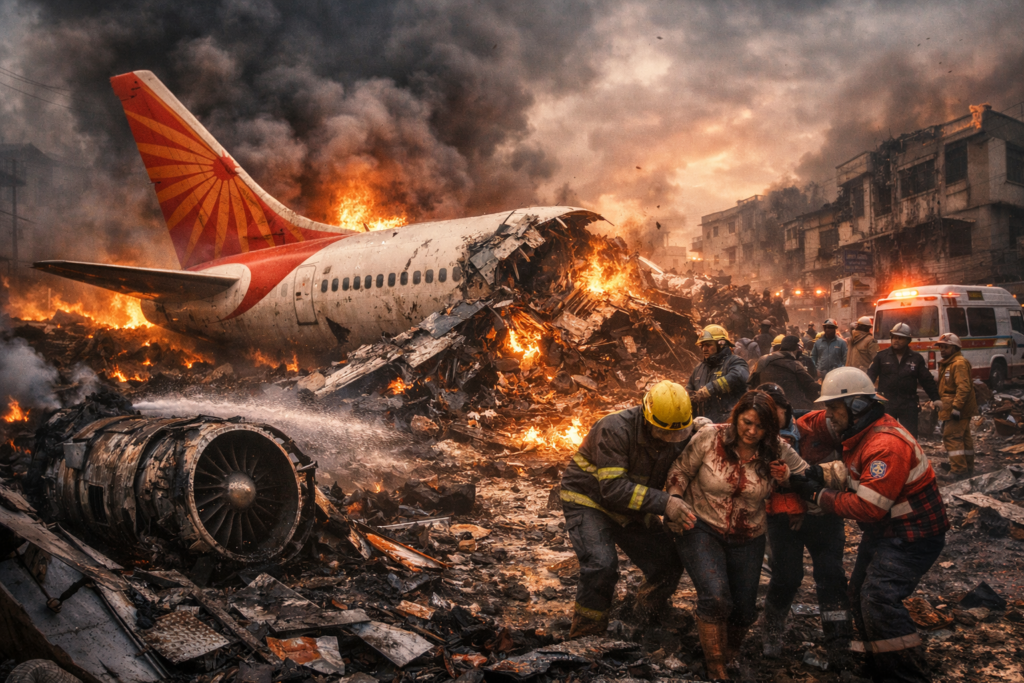
Air travel is often described as one of the safest forms of transportation. Millions of flights depart and land around the world every year without incident. That’s why, when a major passenger aircraft crashes, the shock travels far beyond the immediate location of the disaster.
In June 2025, a devastating aviation accident reminded the world how quickly routine travel can turn into tragedy. An Air India passenger jet carrying more than 240 people crashed shortly after takeoff from Ahmedabad, India, while on a flight to London Gatwick.
The disaster unfolded within minutes of departure, leaving investigators, aviation experts, and families searching for answers.
The Flight That Never Reached Cruising Altitude
The aircraft involved in the accident was a Boeing 787-8 Dreamliner, a modern long-haul jet used by airlines worldwide. Introduced in the early 2010s, the aircraft has been widely praised for its fuel efficiency and advanced technology.
On the day of the crash, the plane had just begun its journey to the United Kingdom when something went wrong shortly after takeoff.
Reports indicate the aircraft reached only a few hundred feet above the ground before losing altitude. Moments later, it crashed into a residential area of the city, sending smoke and debris into the sky.
Air traffic records show that the pilots issued a mayday call shortly after departure, signaling that a serious problem had developed during the climb phase of the flight.
Within minutes, the aircraft was no longer airborne.
Who Was Onboard
According to aviation officials and airline statements, the plane carried over 240 people, including passengers and crew members.
The group represented several nationalities. Most passengers were from India, but there were also travelers from the United Kingdom, Portugal, and Canada.
Such international passenger lists are common on long-haul flights between major global cities.
But tragedies like this reveal how aviation disasters can quickly become international events, affecting families and communities across multiple countries.
Why Takeoff Is One of the Most Critical Moments
Aviation experts often point out that the most dangerous phases of flight are takeoff and landing. These are the moments when aircraft operate closest to the ground and have the least time to recover from unexpected problems.
In this particular case, the aircraft reportedly reached only about 600 feet before losing signal on tracking systems.
At that altitude, pilots have extremely limited time to respond if a serious mechanical failure occurs.
Investigators typically focus on several key areas when examining accidents that happen shortly after departure:
- Engine performance
- Aircraft configuration (flaps and slats)
- Flight control systems
- Possible mechanical malfunctions
- External factors such as weather or bird strikes
Early reports indicated that weather conditions were stable at the time of the flight, which means investigators may concentrate more heavily on technical or operational factors.
The Devastating Impact on the Ground
Unlike accidents that occur over water or remote areas, crashes in populated locations can have consequences far beyond the aircraft itself.
When the plane came down in Ahmedabad, it struck a residential area connected to a medical campus, causing additional casualties on the ground.
Emergency responders rushed to the scene within minutes. Fire crews, medical teams, and rescue units worked through wreckage and flames while trying to locate survivors.
Despite the scale of the disaster, reports later confirmed that one passenger miraculously survived the crash after escaping from the wreckage.
Stories like this often capture global attention because survival in such events is extremely rare.
The Investigation That Follows
When major aviation accidents occur, investigations typically involve multiple organizations.
Authorities from the country where the crash happened usually lead the investigation, but aircraft manufacturers, airline representatives, and international aviation agencies often participate as well.
In this case, teams connected to Boeing, engine manufacturers, and aviation safety regulators began examining possible causes.
One of the most critical pieces of evidence is the aircraft’s “black box,” which includes:
- The Flight Data Recorder (FDR), storing technical performance data
- The Cockpit Voice Recorder (CVR), capturing conversations between pilots
These devices help investigators reconstruct the final moments of a flight.
By analyzing altitude changes, engine behavior, and cockpit communication, experts can determine what may have triggered the accident.
Aviation Safety and the Bigger Picture
While aviation accidents receive intense global attention, they remain statistically rare compared with the enormous number of flights that operate every day.
Modern aircraft include multiple redundant systems designed to prevent failures from becoming catastrophic events. Pilots also undergo extensive training for emergency scenarios.
However, when accidents do occur, the aviation industry often uses them as opportunities to improve safety systems.
Past investigations have led to:
- New maintenance procedures
- Updated pilot training standards
- Improved aircraft design
- Enhanced safety regulations worldwide
These changes have helped reduce accident rates over time.
A Tragedy Felt Across Borders
For families and communities affected by aviation disasters, statistics and investigations provide little immediate comfort.
Behind every passenger manifest are individual lives—people traveling for business, visiting loved ones, or beginning vacations.
The crash in Ahmedabad became one of the most devastating aviation disasters in recent years, with hundreds of lives lost both onboard and on the ground.
Global leaders, aviation authorities, and airline officials all expressed condolences in the aftermath.
But the deeper impact remains personal for the families left behind.
Remembering the Human Story
Aviation accidents are often remembered for the numbers attached to them: passengers onboard, casualties reported, investigation findings.
Yet each event also carries countless personal stories that rarely make headlines.
The passengers on that flight boarded expecting a routine journey between two major cities.
Instead, the flight became a moment that the aviation world—and many families around the globe—will remember for years to come.