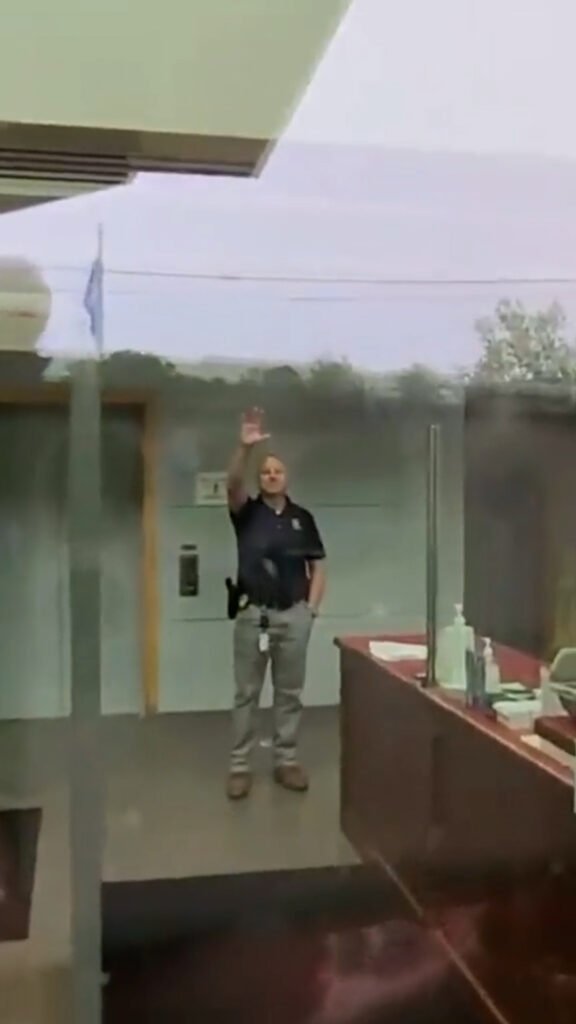
The lobby smelled like disinfectant and rain. Fluorescent bulbs hummed above polished floors; a thick sheet of safety glass split the room in two—the public on one side, authority on the other. A man lifted his phone and pressed record. On the far side, a uniformed employee raised his palm, hovering in the air like a stop sign that never touched the ground.
“You can’t film in here,” the voice came dully through the speaker slot.
“This is a public lobby,” the man answered, steady. “I’m here to document my visit.”
For a moment it was only their breathing and the camera’s tiny red dot. A printer chattered somewhere in back. The employee shifted, one hand near his belt, the other still up—half wave, half warning. A second staffer peeked from a doorway, then disappeared. The room felt smaller than it was.
The man didn’t move closer; he didn’t move away. He narrated, softly, as if explaining the weather.
“This is where the line is: glass, rules, and the public’s right to know.”
Outside, a cruiser idled. Two officers entered, boots thudding against the echoey floor. Their tone was brisk but careful—the kind of careful that comes from knowing the whole world could be listening later.
“Sir, what’s the purpose of your recording?”
“Matters of public interest,” he said. “I’m not disrupting anything. Just filming from a publicly accessible area.”
One officer glanced at the posted rules. Another looked into the camera as if seeing himself tomorrow. They had heard of people like this—citizens with cameras who test the edges of power and policy. The encounters go viral, departments issue statements, commentators pick sides. The officer sighed.
“As long as you don’t interfere with operations,” he said finally, “you can remain.”
The man nodded, the phone steady. The employee behind the glass lowered his hand. It wasn’t a victory march; it wasn’t a defeat. It was a moment where process held, where a lobby remained a lobby—a place where the public could be present, even when presence felt inconvenient.
Later that week, conversations about filming public officials and accessible spaces flared again online. Newsrooms and local outlets traced how “audits” of lobbies and counters keep forcing agencies to balance workflow with rights: one report described how this auditor movement frames these encounters as accountability tests, and how departments are learning—sometimes awkwardly—where policy ends and the First Amendment begins. East Lansing Info
In a separate, widely covered thread of events, a series of confrontations between auditors and a state police sergeant in Connecticut—first linked to disputes in and around police facilities—would later spark investigations, retirement, and charges, underscoring how quickly small lobby moments can ripple outward into headlines, discipline, and lawsuits. https://www.wfsb.com+2News-Times+2
That night, the lobby lights clicked off one by one. The glass stayed where it always was. The camera feed found home on a platform, and thousands of strangers stepped into the room that had felt so small. The hand that had hovered like a stop sign became a freeze-frame—a question about who gets to look, and who decides when looking becomes too much.
“Public space,” the man said in his upload, “means the public gets to see it.”
Reflection
Rights are rarely loud; they’re a quiet insistence—standing, documenting, refusing to escalate. On the other side of the glass, policies and habits push back. But in these lobbies, when cooler heads prevail, both sides remember that transparency isn’t a courtesy. It’s part of the job.

