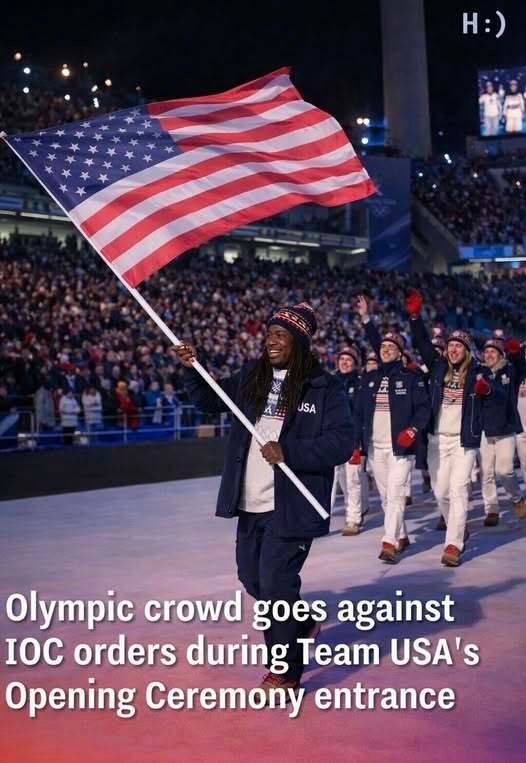
The moment was meant to be ceremonial.
As Team USA entered the stadium during the Olympic opening ceremony, cameras swept across the athletes, flags waved, and the familiar rhythm of national introductions unfolded. Yet within minutes, attention shifted away from pageantry and toward something less scripted: the crowd’s reaction.
Some viewers described the response as muted. Others heard boos mixed with applause. Online, clips circulated rapidly, and interpretations multiplied just as fast. What should have been a unifying spectacle became a point of debate — not only about what happened in the stadium, but about what it meant.
What People Thought They Heard
Opening ceremonies are designed for global television audiences, not just those seated in the arena. Sound is filtered through broadcast microphones, production choices, and commentary overlays.
That reality complicates interpretation.
Some viewers insisted the crowd’s reaction to Team USA felt noticeably cooler compared to other delegations. Others argued the audio was distorted, or that cheers were simply less dramatic due to pacing, acoustics, or camera cuts.
Without a single, uncontested angle, perception filled the gaps.
In the age of short clips and instant replay, perception often hardens into narrative.
The Symbolism of the Olympic Entrance
An Olympic entrance is never just about athletes walking into a stadium.
It carries layers of symbolism — national identity, global politics, and cultural projection. For countries with significant global influence, including the United States, those layers can be especially heavy.
Team USA’s presence often arrives with heightened expectations. Applause can be read as approval. Silence can be interpreted as critique. Even neutrality can feel loaded.
This makes reactions unusually sensitive to interpretation, particularly when geopolitical tensions exist in the background.
Context Matters More Than Volume
Crowd reactions at large international events are rarely uniform.
Spectators come from dozens of countries, each bringing their own loyalties and perspectives. Applause often fluctuates depending on where cameras are positioned and how sound is mixed for broadcast.
In some cases, cheers that feel overwhelming in person may sound subdued on television. In others, isolated reactions can appear amplified.
Experts in live-event production frequently note that broadcast audio is curated, not raw. That curation shapes how viewers understand the moment.
Why the Reaction Became a Story
Not every entrance sparks debate. So why this one?
Part of the answer lies in timing. International sporting events now unfold in a hyper-political media environment. Audiences are primed to read meaning into tone and reception.
Social media accelerates that tendency.
Within minutes of Team USA’s entrance, commentary framed the moment as symbolic — evidence of global sentiment, cultural fatigue, or political disagreement. Once that framing took hold, it traveled faster than verification.
The entrance became a proxy for larger conversations.
Divided Interpretations Online
Online reactions quickly split into camps.
Some argued the response reflected genuine crowd sentiment, pointing to audible dips in applause or visible reactions in certain clips. Others dismissed the idea entirely, calling it an overreaction driven by selective editing.
Still others suggested the debate itself was misplaced — that opening ceremonies are theatrical constructs, not opinion polls.
Each interpretation said as much about the viewer as the event.
The Weight Carried by Team USA
American athletes often arrive at the Olympics carrying symbolic weight beyond sport.
They represent not just individual achievement, but national narratives projected onto a global stage. That visibility can amplify scrutiny, even when athletes themselves remain apolitical.
For competitors, the entrance is typically a moment of pride and focus — a brief pause before weeks of performance pressure. The external debate rarely reflects their internal experience.
Most athletes are thinking about competition, not commentary.
Media Framing and Its Consequences
Once headlines frame an event as controversial, that framing shapes memory.
Future references to the ceremony may include the debate as part of the story, regardless of its factual clarity. This is how moments become “controversial” even when evidence remains ambiguous.
The repetition of a question — Were they booed? — can matter more than the answer.
That dynamic highlights the power of media framing in shaping collective perception.
A Ceremony Designed for Unity, Interpreted Through Division
The Olympic opening ceremony is intended to emphasize shared humanity through sport. Athletes march together, national differences temporarily softened by a common stage.
Yet interpretation does not pause for intention.
Viewers bring their own contexts, frustrations, and expectations. In that sense, the debate surrounding Team USA’s entrance reflects broader global tensions rather than a single moment in a stadium.
The ceremony becomes a mirror, not a message.
What Remains After the Noise
As competitions continue, attention inevitably shifts back to performance — medals won, records broken, stories of resilience and effort.
The entrance fades into background memory.
For Team USA athletes, the significance lies not in the volume of applause, but in what follows on the field, track, or mat.
Crowd reactions may spark headlines, but they do not determine outcomes.
A Moment Interpreted, Not Defined
The discussion around Team USA’s Olympic entrance illustrates how modern sports moments are no longer self-contained. They are filtered through technology, politics, and digital culture.
What one person hears as indifference, another hears as normal ceremony noise. What one clip suggests, another contradicts.
In the absence of certainty, interpretation fills the space.
Ultimately, the entrance was a moment — brief, symbolic, and heavily mediated. Its meaning depends less on decibels and more on the lens through which it was viewed.
And as with many Olympic moments, the lasting legacy will likely be written not in applause, but in performance.