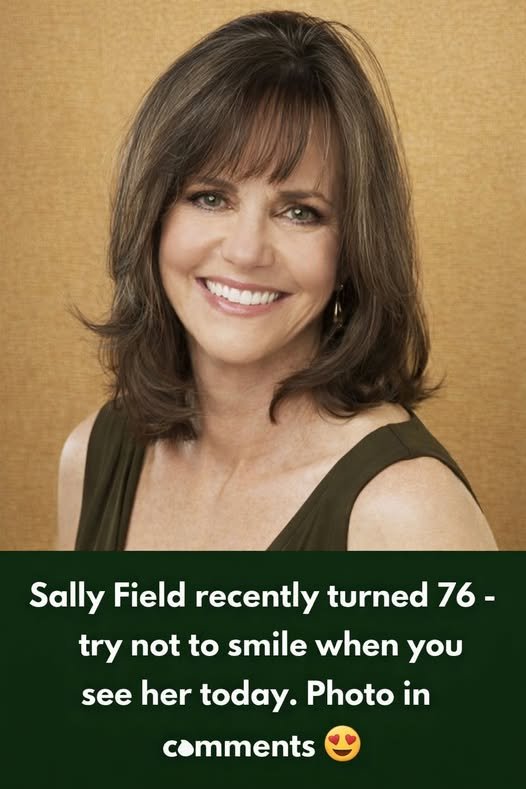
There is a particular stillness that comes with experience. It’s not loud or attention-seeking. It doesn’t rush to prove itself. When Sally Field speaks about aging, that quiet confidence is unmistakable.
At 76, the two-time Oscar winner no longer seems concerned with how Hollywood sees her. Instead, she appears more interested in how she sees herself — and what it means to keep growing in an industry that has rarely been gentle with women over 40.
For decades, Field has moved between television and film, comedy and drama, ingénue roles and maternal figures. But in recent interviews, her reflections have taken on a more personal tone. Aging, she suggests, is not something to resist. It is something to understand.
Growing Older in an Industry That Worships Youth
Hollywood has long had a complicated relationship with aging — particularly for women. Careers often peak early, visibility narrows with time, and scripts become more limited. It’s a reality many actresses have quietly endured.
Field, however, speaks about it without bitterness.
She has acknowledged that aging brings changes that are sometimes uncomfortable. The body shifts. Energy fluctuates. Public perception evolves. But she frames those realities not as losses, but as transitions. There is freedom, she implies, in no longer chasing approval.
That perspective didn’t arrive overnight.
Field entered the spotlight in the 1960s with television roles that leaned heavily on charm and youthful appeal. Later came serious dramatic work that demanded emotional depth and vulnerability. Over time, the industry’s expectations changed — and so did she.
Instead of clinging to past versions of herself, she adapted.
Strength That Isn’t Always Visible
When people talk about strength in Hollywood, they often mean box office power or award wins. Field’s idea of strength seems quieter.
It’s the strength of surviving decades in a competitive environment. The strength of raising a family while building a career. The strength of acknowledging insecurities instead of denying them.
In discussing aging, she has been candid about feeling self-conscious at times. That honesty resonates because it feels real. There’s no attempt to package the experience into a glossy narrative of effortless confidence.
Aging, she has suggested, can be humbling. It forces you to reckon with time. But it also offers clarity.
There comes a point, she implies, when the pressure to please fades. What remains is the work — and the person doing it.
Redefining Beauty and Relevance
In an era saturated with filters, cosmetic procedures, and endless commentary about appearance, Field’s approach stands out. She has been open about embracing the natural process of growing older.
This stance is not framed as rebellion. It is framed as acceptance.
That distinction matters.
Rather than presenting aging as a battle to be fought, she treats it as an inevitability to be respected. Wrinkles are not a failure. Changing features are not a defeat. They are evidence of time lived.
In doing so, she subtly challenges the idea that relevance is tied to youth.
Hollywood may still chase the next breakout star, but audiences increasingly value authenticity. Field’s willingness to show up as she is — without apology — reflects that shift.
The Long Arc of a Career
Few actors maintain longevity across generations. Fewer still remain culturally recognizable for more than half a century. Field’s career spans sitcom fame, Oscar-winning performances, political dramas, romantic comedies, and prestige television.
That arc did not unfold in a straight line.
There were moments of doubt. Roles that didn’t land. Periods of transition. But stepping back, the throughline becomes clear: persistence.
She has often spoken about the importance of meaningful work over constant visibility. That mindset may explain her endurance. Instead of chasing trends, she gravitates toward roles that feel substantial.
The result is a body of work that feels cohesive rather than frantic.
Aging as Expansion, Not Decline
Public conversations about aging tend to focus on what is lost — youth, speed, appearance. Field’s reflections suggest a different framing.
With age, she notes, comes perspective.
There is less urgency to impress. More willingness to speak honestly. A deeper understanding of what truly matters. Those shifts don’t erase the physical realities of getting older, but they recontextualize them.
In that sense, aging becomes an expansion of identity rather than a shrinking of opportunity.
It also changes how success is measured.
For someone who has already reached the highest professional accolades, validation from awards or headlines becomes less central. Fulfillment may come instead from collaboration, storytelling, and personal peace.
A Broader Cultural Shift
Field’s comments arrive at a moment when conversations around age in entertainment are evolving. Streaming platforms have widened the range of stories being told. Audiences are showing interest in narratives centered on later chapters of life.
Actresses in their 60s and 70s are leading series, headlining films, and producing their own projects. While ageism has not disappeared, the boundaries are stretching.
Field’s openness contributes to that shift.
When established figures speak candidly about aging, it reframes the conversation for those watching from the sidelines. It offers an alternative to the silent pressure many feel to remain perpetually youthful.
Her message is not that aging is effortless. It is that it is natural — and survivable.
Living Beyond the Spotlight
Perhaps the most striking element of Field’s recent reflections is their calmness. There is no dramatic declaration, no sweeping manifesto.
Instead, there is steadiness.
She acknowledges the discomforts of aging without dramatizing them. She celebrates resilience without boasting. She speaks about Hollywood not as a battlefield, but as a landscape she has learned to navigate.
That tone carries weight precisely because it avoids spectacle.
In a culture that often amplifies extremes, measured perspective feels rare.
The View From 76
At 76, Sally Field is not attempting reinvention for reinvention’s sake. She is reflecting on a life lived publicly and privately, on the costs and rewards of longevity, on the meaning of strength when the spotlight dims slightly but does not disappear.
Aging, in her telling, is neither tragic nor triumphant. It simply is.
And perhaps that is the quiet lesson embedded in her words: that life, even in Hollywood, is less about defying time and more about moving with it.
In the end, the measure of a career — or a life — may not be how long youth is preserved, but how fully each stage is inhabited.