Sometimes a political speech is remembered for a policy proposal. Sometimes it is remembered for a line. And sometimes, what lingers most is not what was said at the podium, but what happened around it.
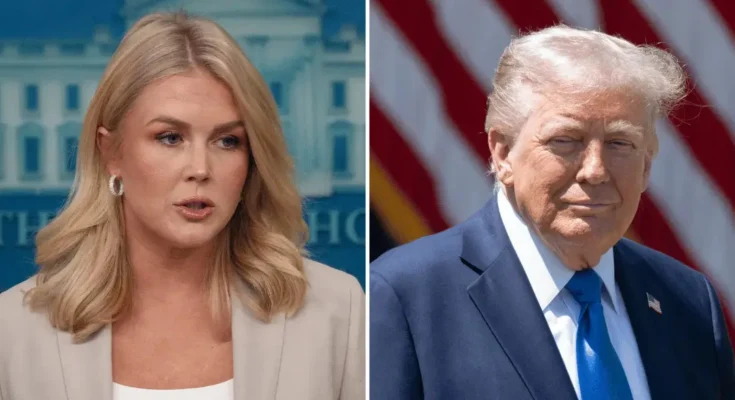
That was the case after President Donald Trump’s State of the Union address, when attention quickly shifted from the speech itself to the reaction inside the chamber. The most discussed moments were not only Trump’s remarks, but the visible response from Democratic lawmakers as he recognized several guests tied to crime, immigration, and personal loss. According to White House press secretary Karoline Leavitt, that reaction was not incidental. She argued it was exactly the outcome Trump wanted.
In her telling, Democrats did not simply disagree with the speech. They walked into a moment designed to expose that disagreement as clearly as possible on live television.
The Argument Leavitt Is Making
Speaking on Fox News, Leavitt said Democrats “fell right into” what she described as a political trap during the address. Her claim was that Trump intentionally included emotionally charged recognitions in the speech so that the camera would capture who stood, who applauded, and who remained seated.
Leavitt framed those reactions as revealing. In her view, when Democratic lawmakers largely declined to stand during certain moments, they showed voters where they stood on issues such as illegal immigration, violent crime, and public safety.
That interpretation has become the real center of the story. The speech may have covered a wide range of topics, but the political afterlife of the event has focused on those seconds of visible contrast in the room.
The Guests Who Turned a Speech Into a Test
The moments at issue involved guests Trump highlighted during the address. Among them was Anna Zarutska, the mother of Iryna Zarutska, a Charlotte victim in a fatal rail-stabbing case. Trump also recognized 7-year-old Dalilah Coleman, who suffered critical injuries after a crash involving an undocumented truck driver, and Erika Kirk, the widow of Charlie Kirk.
Leavitt pointed specifically to those recognitions when criticizing Democrats’ response. She said lawmakers “could not even stand” for grieving family members and a badly injured child, arguing that their reaction reinforced the broader message Trump wanted viewers to take from the night.
That is what gives the controversy its power. These were not abstract policy references. They were personal stories placed at the center of a national broadcast.
Why the Reaction Mattered So Much
A State of the Union address is never just a speech. It is a stage-managed political event where symbolism matters almost as much as substance. Every pause, every camera angle, and every reaction shot can be used to shape the broader narrative.
That is why the chamber itself became part of the message.
When Trump challenged lawmakers in moral and political terms, the response was immediately legible to viewers at home. Standing could be interpreted as support for the victims being honored. Remaining seated could be framed as opposition, indifference, or refusal to participate in Trump’s messaging. The White House appears to be betting that this kind of visual contrast is more powerful than a long policy argument.
In modern political media, moments like these travel faster than full speeches. They become clips, headlines, and talking points within minutes.
The Strategy Behind the Scene
Leavitt went further than simple criticism. She said the setup was deliberate and called it “his idea” to include that kind of challenge in the speech. According to her, Trump wanted voters to see the choice in stark terms: Republicans standing with “common sense” and Democrats, in her telling, standing only in opposition to him.
Whether one agrees with that framing or not, it reflects a broader communication strategy that has become increasingly common in national politics. Rather than trying to create consensus in the room, the goal is often to produce a moment that defines the opposition in front of a mass audience.
This is part of why Leavitt’s comments matter. She is not describing an unfortunate breakdown in decorum. She is describing a successful political outcome.
More Than a Speech About Policy
What happened here also says something about the current state of political communication. The old model of a major presidential address emphasized persuasion through policy, reassurance, and national unity. The newer model often treats the event as a vehicle for contrast.
In that version, the speech is only one layer. The real objective is to create a clean dividing line and make the opposition react in full view of the public.
That appears to be how the White House wants this address remembered. Not as a long list of proposals, but as a moment when Democrats, in Leavitt’s words, showed their “true colors.”
Why This Became the Lasting Headline
The reason this story has lasted beyond the speech itself is simple: it condensed a larger political argument into a visual scene. A president highlighted victims and grieving families. Many lawmakers on the other side did not rise. The White House then moved quickly to define that image before anyone else could.
For supporters of Trump, it was proof that Democrats were unwilling to stand with people harmed by weak border enforcement and crime. For critics, it was a calculated effort to force a binary reaction in a setting where nuance disappears. Both readings are political. But only one of them currently dominates the headline attached to Leavitt’s remarks.
The Moment That Will Outlast the Speech
In the end, Leavitt’s argument is less about one line from Trump than about one reaction from the chamber.
That is why the story has held attention. The administration believes Democrats were presented with a public test and failed it. The opposition may see the scene differently, but the visual politics of the night gave the White House exactly what it wanted: a clip, a contrast, and a message simple enough to travel far beyond the Capitol.
And in today’s political landscape, that may be the part that matters most.