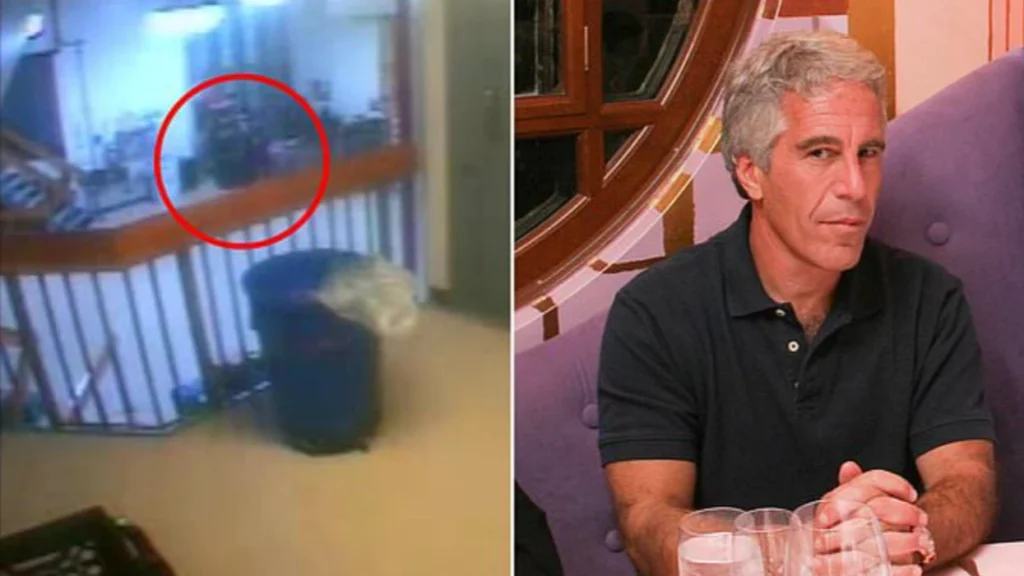
The hallway was still.
Early light filtered through narrow windows inside Manhattan’s Metropolitan Correctional Center, casting pale reflections on polished floors. It was supposed to be another routine shift — keys clipped to belts, doors opening and closing, guards moving through familiar corridors.
Then something felt wrong.
Within minutes, the calm broke. Officers hurried toward a single cell in the facility’s special housing unit. Radios crackled. Footsteps quickened. What they found inside would become one of the most scrutinized moments in modern criminal history.
Jeffrey Epstein was unresponsive.
Years later, newly released surveillance footage has brought that morning back into focus, offering a rare visual record of the instant prison staff realized the high-profile inmate was dead.
Not answers — but atmosphere.
And for many, that’s enough to reopen questions that never fully closed.
A Glimpse Into a Moment the World Has Debated for Years
The video itself is stark and silent.
Captured by internal security cameras, it shows guards moving through the unit shortly after Epstein failed to respond during routine checks. One officer approaches the area outside his cell. Moments later, several others converge. The urgency becomes visible even without sound.
There’s no dramatic reveal. No cinematic climax.
Just people doing their jobs — and suddenly realizing they’re standing inside a crisis.
The footage does not show Epstein inside the cell. It doesn’t capture his final moments. It documents only the discovery: staff entering the corridor, opening the door, attempting emergency procedures, and eventually escorting medical personnel into the unit.
Shortly afterward, Epstein was transported to a nearby hospital, where he was pronounced dead.
The date was August 10, 2019.
Why This Footage Is Surfacing Now
The release comes as part of a broader disclosure of materials tied to Epstein’s detention, including surveillance segments that were previously unavailable to the public.
For years, officials maintained that technical issues and storage limitations prevented a complete record of the night Epstein died. Some cameras malfunctioned. Others failed to capture key angles. Entire stretches of video were missing.
That vacuum of information became fertile ground for speculation.
Now, this clip adds texture to the official timeline — even if it doesn’t fill in the most controversial gaps.
It shows what happened after Epstein was found, not before.
And that distinction matters.
The Official Story, and the Questions That Followed
Authorities ultimately ruled Epstein’s death a suicide by hanging.
But almost immediately, that conclusion collided with uncomfortable realities.
Epstein had been taken off suicide watch weeks earlier despite a prior incident in his cell. He was supposed to have a cellmate at the time of his death, yet he was alone. Guards assigned to check on him reportedly fell asleep. Required rounds weren’t completed. Surveillance systems failed.
Each of those details might seem minor on its own.
Together, they painted a picture of institutional breakdown.
A Justice Department investigation later confirmed widespread failures inside the facility — staffing shortages, exhausted employees, procedural lapses, and outdated infrastructure. Two guards were charged with falsifying records, though the case eventually ended in a deferred prosecution agreement.
No one was convicted in connection with Epstein’s death.
For many observers, that outcome felt incomplete.
What the Video Shows — and What It Doesn’t
Watching the footage now, the most striking thing is how ordinary it looks.
There’s no chaos at first. No visible panic. Just a few officers moving quickly down a corridor, followed by more staff arriving seconds later.
It feels procedural.
Almost subdued.
But that restraint is part of what makes the video unsettling. This wasn’t a dramatic movie scene. It was a workplace emergency unfolding inside concrete walls, far from public view.
Still, the clip leaves out the moments people care about most:
- Epstein’s final interactions
- Whether checks were actually performed overnight
- What happened in the critical minutes before he was found
- Why key cameras weren’t functioning
Those absences remain.
And they’re why this story refuses to fade.
A Death That Changed More Than One Case
Epstein’s passing didn’t just end a criminal prosecution. It altered dozens of lives and legal paths.
Victims lost their chance to see him stand trial.
Civil lawsuits accelerated. Investigations shifted focus to his associates. Public trust in federal detention facilities took another hit.
The case also forced a reckoning with how high-risk inmates are managed in overcrowded prisons — especially when notoriety collides with underfunded systems.
In the years since, reforms have been discussed, audits conducted, and leadership reshuffled. But critics argue the structural problems remain largely intact.
The footage arriving now feels less like a revelation and more like a reminder.
Why People Still Can’t Look Away
Jeffrey Epstein wasn’t just another defendant.
He was connected to politicians, royalty, billionaires, and celebrities. His private jet had its own nickname. His properties spanned continents. His crimes implicated power itself.
So when someone like that dies in custody — under questionable supervision — disbelief becomes inevitable.
The newly released video doesn’t validate conspiracy theories. It doesn’t expose hidden villains. But it reinforces a deeper discomfort: that a man accused of trafficking minors slipped through a system designed to hold him accountable.
What remains is a sense of unfinished business.
Not legally — but emotionally.
A Quiet Ending to a Loud Scandal
The footage shows guards moving through a hallway on an otherwise unremarkable morning.
No crowds.
No cameras.
No headlines yet.
Just people discovering that one of the most infamous figures of the decade was suddenly gone.
It’s a small slice of time, preserved on security video.
And while it doesn’t solve the mystery surrounding Jeffrey Epstein’s death, it captures something else entirely — the fragile moment when routine gives way to history, and an institution confronts the consequences of its own failures.