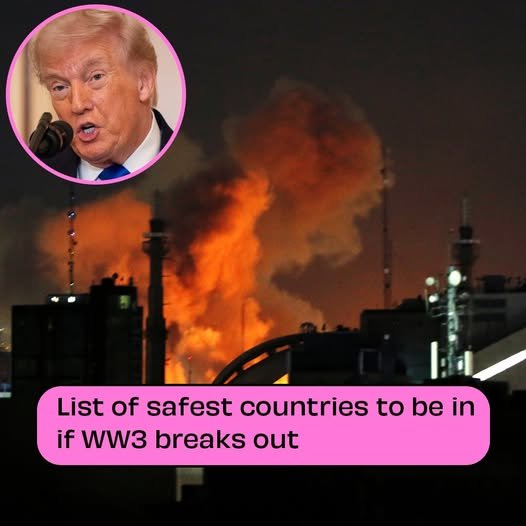
In times of geopolitical tension, people often start asking the same quiet question: Where would actually be safe if the world became unstable?
It’s not a new thought. Throughout history, whenever large conflicts seemed possible, individuals have looked at maps differently—studying distance, terrain, and alliances in search of places that might offer protection from the chaos of war.
Today, that curiosity still appears whenever global tensions rise. Discussions about “safe countries” surface across social media and news commentary, often pointing to a handful of places believed to be less exposed to large military confrontations.
While no nation is completely immune to the effects of global conflict, certain geographic and political factors may reduce the likelihood of becoming a direct battlefield.
Distance From Major Powers
One of the most obvious advantages in times of conflict is simple geography.
Countries located far from major military powers or strategic targets tend to attract less attention during large-scale wars. Remote island nations, for example, may sit outside the primary routes used by large military forces.
This natural separation doesn’t guarantee safety, but it can reduce the probability of direct involvement.
Distance has historically played a role in how conflicts spread. Regions far from the centers of power sometimes experience fewer immediate disruptions, at least in the early stages of a crisis.
The Quiet Advantage of Isolation
Some countries benefit from a degree of geographic isolation that naturally limits strategic interest from other nations.
Island states scattered across large oceans often fall into this category. Their distance from large continents and military alliances can make them less attractive as targets during major conflicts.
Nations such as New Zealand and Iceland are frequently mentioned in these conversations because of their remote locations and relatively stable political systems.
Both countries are known for strong infrastructure and reliable governance—two factors that can be important during periods of global uncertainty.
Neutrality as a Strategy
Geography isn’t the only factor that shapes national security.
Political neutrality has historically helped some countries avoid direct involvement in wars between larger powers. Switzerland, for instance, is often cited as an example of a nation that has carefully maintained neutrality for centuries.
Its diplomatic tradition, combined with mountainous terrain and strong civil defense systems, has contributed to its reputation as a secure location during turbulent periods in European history.
Ireland also maintains a policy of military neutrality, which sometimes places it outside the center of geopolitical disputes.
The Importance of Stability
Safety during global instability depends on more than location.
A country’s internal stability—its government institutions, economy, and social systems—can be just as important. Nations with strong public services, reliable infrastructure, and emergency preparedness may be better equipped to handle disruptions.
Access to resources also plays a role. Countries capable of producing food and maintaining energy supplies are generally more resilient when international trade becomes uncertain.
These factors often influence how quickly a nation can adapt during crises.
Modern Conflicts Reach Farther
Despite discussions about “safe” locations, experts frequently point out that modern conflicts rarely remain confined to one region.
Economic shocks, cyberattacks, and supply chain disruptions can affect countries far removed from military operations. Global markets are deeply interconnected, meaning instability in one part of the world can ripple outward quickly.
Even nations geographically distant from conflict zones may feel indirect consequences through trade, migration patterns, or financial markets.
In other words, isolation alone no longer guarantees protection.
Why People Still Ask the Question
The idea of safe places during conflict often reflects a deeper human instinct: the search for stability.
When the global news cycle becomes dominated by rising tensions or military headlines, people naturally wonder where stability might exist if the situation worsens.
Maps become more than geography—they become symbols of security.
Yet history also shows that the safest societies are often those that prioritize diplomacy and cooperation rather than distance from the world.
A World Where Safety Is Shared
Ultimately, the concept of a “safe country” during global conflict is complicated.
Geography, neutrality, and political stability can all influence how a nation experiences global turmoil. But in a deeply interconnected world, no country exists entirely in isolation.
Security increasingly depends not only on borders and distance but also on international cooperation and the ability of nations to prevent conflict from escalating.
In the end, the places that feel safest are often those where stability, diplomacy, and resilience come together—reminding us that peace is rarely defined by geography alone.