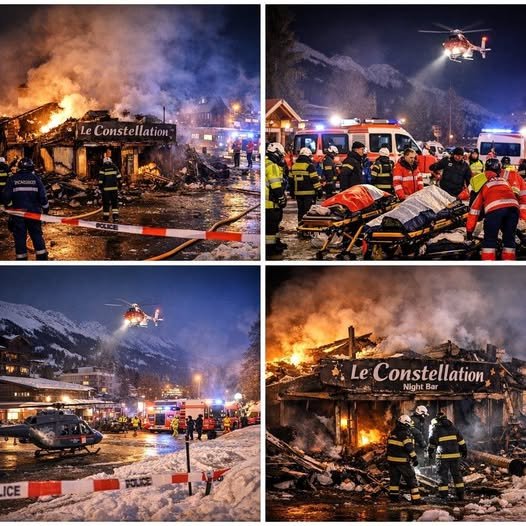
What turns a festive gathering into a disaster is rarely a single spark—it’s a chain reaction.
That is the central reality behind what has come to be known as the “Constellation Tragedy,” a devastating fire that transformed a New Year’s Eve celebration in Crans-Montana into a scene of panic, loss, and national reflection. What began as a night of music, lights, and anticipation ended in seconds, leaving behind questions not only about what happened—but why it escalated so quickly.
Understanding this event requires looking beyond the headline and into the conditions that allowed it to unfold.
When the Environment Becomes the Risk
The fire reportedly started near the stage area of the venue, but the speed at which it spread is what defines the tragedy.
In enclosed public spaces, fire doesn’t always behave gradually. Under certain conditions, it can reach a phenomenon known as “flashover”—a point where nearly every combustible surface ignites almost at once.
Several factors likely contributed to that rapid escalation:
- High fuel load: Decorative materials, acoustic panels, and synthetic installations can burn intensely and release toxic smoke.
- Confined space: Limited airflow combined with heat buildup creates the conditions for explosive ignition.
- Accelerated airflow: Once structural barriers are breached, incoming air can feed flames instead of suppressing them.
These elements don’t act separately. They combine, creating a situation where the transition from safe to catastrophic happens in moments.
Why Visibility Collapses First
In many fire incidents, flames are not the first threat—smoke is.
As the article suggests, visibility inside the venue dropped quickly. Dense smoke fills space faster than people expect, removing the ability to orient, recognize exits, or even understand what direction to move.
This creates what survivors described as a psychological “maze.”
Without clear sightlines, people rely on instinct rather than logic. That instinct often leads them back toward familiar paths—the entrance they used to get in—even if safer exits are closer.
The Hidden Complexity of Crowd Behavior
Crowd dynamics play a critical role in emergencies, especially in enclosed spaces.
When panic begins, behavior shifts:
- Individuals stop acting independently and begin following others
- Bottlenecks form at known exits
- Movement slows as confusion increases
One of the most common patterns is what experts call “exit bias.” People instinctively try to leave through the same doorway they entered, even when alternative routes exist.
This creates dangerous congestion.
In high-density environments, that congestion can quickly turn into physical risk—falls, crushing pressure, and blocked escape routes.
When Sound Becomes a Barrier
An unexpected detail in the event is the role of sound.
Music, which had been central to the celebration, may have initially masked the early signs of danger—the crackling of flames, alarms, or warnings from staff. By the time the reality became clear, the environment had already changed.
Sound, in that moment, stopped being part of the experience and became part of the confusion.
The Human Response Under Pressure
In situations like this, the psychological impact is immediate.
As smoke spreads and visibility drops, the brain’s ability to process information narrows. People shift from deliberate thinking to rapid survival response.
That response is not always efficient—it’s instinctive.
Survivors often describe:
- Disorientation
- Difficulty recognizing exits
- A sense of being trapped even in open space
This is not a failure of awareness. It’s how the human brain reacts under extreme stress.
What This Tragedy Reveals About Public Safety
Beyond the event itself, the incident highlights broader questions about safety in public venues.
How quickly can people exit a crowded space?
Are emergency routes clearly visible in low visibility?
How do materials used in design affect fire behavior?
These are not abstract concerns. They are structural decisions that can influence whether an incident remains contained—or escalates into a catastrophe.
The tragedy has prompted renewed attention to these factors, especially in venues designed for large gatherings.
The Thin Margin Between Control and Chaos
One of the most striking aspects of this event is how little time there was to react.
Moments before the fire, the venue was described as full of energy and celebration. Within seconds, that environment shifted into confusion and urgency.
That transition is what defines high-risk environments. When conditions align—fuel, space, airflow, and human density—the margin for error disappears.
A Night That Changed More Than It Seemed
What happened in Crans-Montana is not just a story about a fire.
It is a reminder of how environments behave under stress, how quickly systems can fail, and how human instinct interacts with physical space in moments of crisis.
The tragedy did not unfold slowly. It happened all at once.
And in that instant, a night meant for celebration became something else entirely—a moment that continues to shape how safety, design, and preparedness are understood long after the flames were gone.