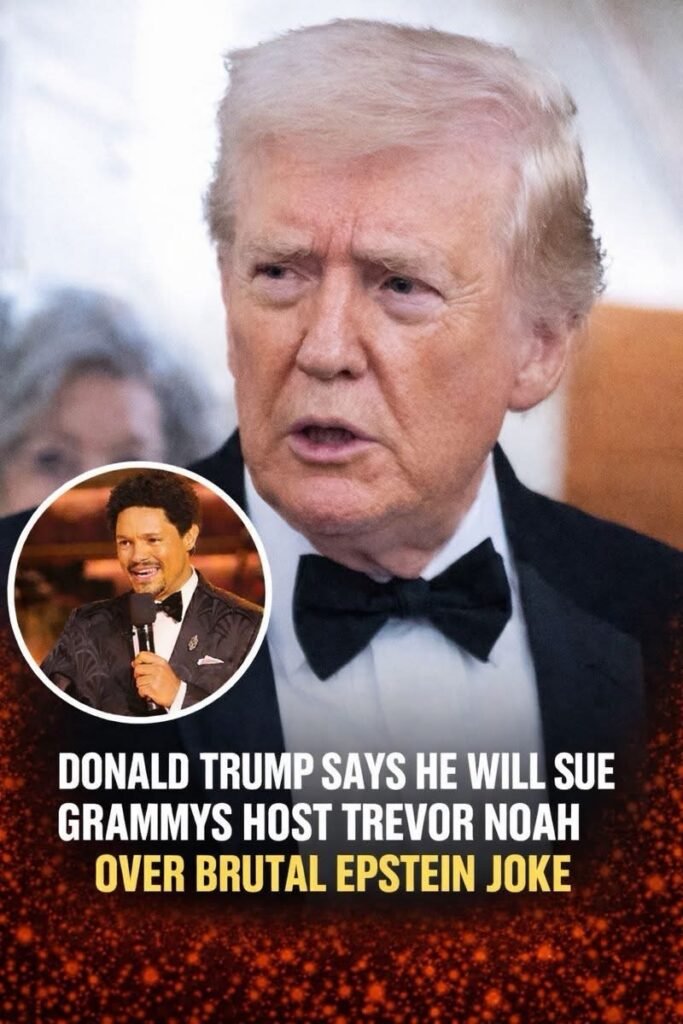
It started the way many modern controversies do — quietly, online, tucked between headlines and trending clips, waiting for someone to share it.
A late-night scroll. A headline flashing across a feed. A claim that sounded dramatic enough to pause on: Donald Trump was supposedly planning to sue Trevor Noah over a joke made at the Grammy Awards.
Within hours, the story had spread. Screenshots circulated. Comment sections filled. Some people laughed. Others argued. A few took it seriously.
And just like that, a single comedy moment had transformed into a viral rumor.
A Joke on a Big Stage
Award shows have always mixed celebration with commentary. Hosts and presenters use humor to lighten the atmosphere, poke fun at celebrities, and reflect on current events.
The Grammys were no exception.
During the ceremony, Trevor Noah delivered a lighthearted remark referencing Donald Trump. It was brief. It fit the tone of the evening. It passed without major disruption.
In the room, the moment felt ordinary — another line in a night full of them.
But online, it would take on a different life.
When Headlines Outpace Reality
Soon after the broadcast, posts began appearing across social media suggesting that Trump was furious about the joke and intended to take legal action.
Some headlines were written to sound urgent.
Others framed it as breaking news.
A few implied inside sources.
To someone scrolling quickly, it looked convincing.
The idea spread fast because it matched familiar expectations: Trump reacting strongly, a comedian under fire, another public dispute.
It felt plausible.
That was enough.
The Search for Confirmation
As the rumor gained attention, some readers began looking for evidence.
Was there a legal filing?
Had Trump’s team issued a statement?
Was any major news outlet reporting it?
The answers were consistent.
No.
There were no court records.
No official announcements.
No credible confirmation.
Major media organizations had not reported any lawsuit.
The story existed almost entirely within the digital echo chamber.
How Viral Claims Take Shape
This kind of rumor doesn’t appear by accident.
It follows a recognizable pattern.
A public figure makes a joke.
Someone reacts emotionally online.
A speculative post is shared.
A headline exaggerates it.
Other sites repeat it.
Social media amplifies it.
Before long, speculation is treated as fact.
Each step adds confidence — even when nothing concrete exists.
By the time readers see the claim, it already feels established.
Trump’s History With Media Criticism
Part of what fueled the rumor was Trump’s well-known relationship with the press and entertainers.
Throughout his political career, he has frequently criticized comedians, journalists, and television hosts who mocked him.
He has publicly threatened legal action in the past.
He has used social media to respond directly to criticism.
Because of this history, the idea of him suing over a joke didn’t seem far-fetched to many people.
Context made the rumor believable.
But believable does not mean true.
Trevor Noah’s Position
From Trevor Noah’s side, there was no indication of concern.
No public response.
No legal preparation.
No acknowledgment of any dispute.
For him, it appeared to be another routine moment of comedy — something comedians experience constantly when addressing political figures.
Silence, in this case, spoke clearly.
Nothing was happening behind the scenes.
The Business of Attention
Why do stories like this spread so easily?
Because attention is valuable.
In the online media economy, clicks generate revenue. Engagement drives visibility. Outrage keeps people scrolling.
A calm headline saying “No Lawsuit Exists” doesn’t travel far.
A dramatic claim suggesting legal war travels everywhere.
Some websites rely on this dynamic.
They package uncertainty as certainty.
They turn speculation into “news.”
They benefit from confusion.
The Cost of Misinformation
While this particular rumor was relatively harmless, the pattern behind it is not.
Repeated exposure to false claims weakens trust.
Readers become unsure what to believe.
Public figures are judged based on fiction.
Conversations shift away from real issues.
Over time, misinformation becomes background noise — constant, exhausting, and damaging.
Even when corrected, rumors leave traces.
Some people never see the clarification.
How Fact-Checking Works in Practice
In this case, verifying the claim required only basic steps:
Search court databases.
Check reputable news sources.
Look for official statements.
Compare multiple outlets.
All pointed to the same conclusion: there was no lawsuit.
No paperwork.
No announcement.
No confirmation.
Just a story built on assumptions.
A Culture of Instant Reactions
Social media encourages immediate responses.
People share before verifying.
They react before reading.
They comment before checking sources.
Speed matters more than accuracy.
This environment makes it easy for rumors to thrive — especially when they involve famous names.
Trump and Trevor Noah both attract attention.
Anything connecting them is likely to spread.
What the Story Reveals
This episode is less about two public figures and more about how modern information moves.
It shows how:
Jokes become controversies Speculation becomes headlines Rumors become “news” Corrections arrive too late
It reflects a media landscape where emotion often travels faster than truth.
The Reality Behind the Rumor
At the end of the day, nothing dramatic happened.
No lawsuit was filed.
No legal battle began.
No confrontation followed.
There was only a joke, a rumor, and a wave of online reaction.
Then, slowly, attention moved elsewhere.
As it always does.
A Quiet Lesson in Media Literacy
Stories like this serve as reminders.
Not every headline is reliable.
Not every viral claim is verified.
Not every trending topic is real.
In a world flooded with information, skepticism is a skill.
Checking sources is a habit.
Pausing before sharing is a responsibility.
When the Noise Fades
The Grammy moment has already faded from most conversations.
The rumor has largely disappeared.
Another topic has replaced it.
Another headline has taken its place.
But the pattern remains.
And it will repeat.
Again and again.
Because in the age of instant news, sometimes the loudest stories are the ones that never actually happened.