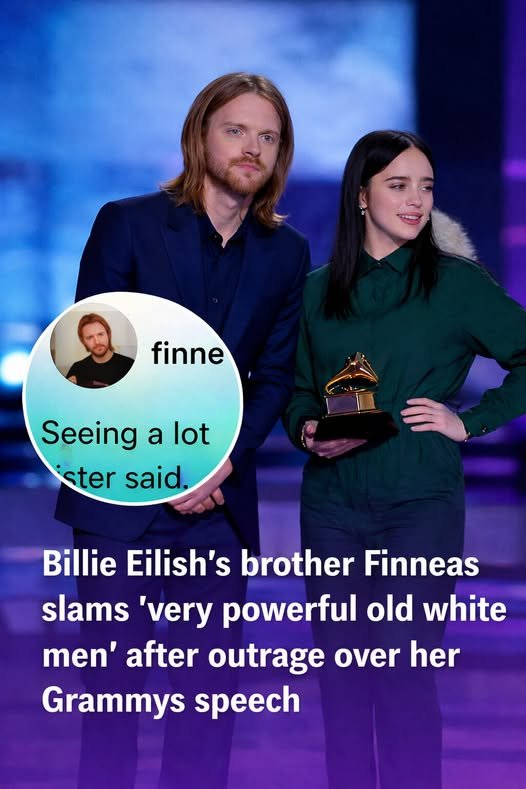
It took only a few minutes on stage for a celebratory moment to turn into an online debate.
When Billie Eilish accepted her award at the Grammys, what should have been a straightforward speech quickly became a lightning rod for commentary. Within hours, clips were circulating, opinions were hardening, and criticism was mounting. Soon after, her brother and longtime collaborator, Finneas, stepped in to address the backlash.
The incident offers more than celebrity drama. It highlights how modern award shows intersect with social media culture — and how quickly narratives can spiral.
What Sparked the Reaction?
Award show speeches have always been scrutinized. But today, they are dissected in real time.
Eilish’s remarks, delivered during one of the night’s biggest moments, were interpreted by some viewers as controversial or poorly timed. Others defended her, arguing that her comments were either misunderstood or taken out of context.
The key detail wasn’t necessarily what she said, but how it was received.
Short clips, often stripped of surrounding context, circulated widely online. As is typical in viral cycles, nuance struggled to keep up with speed.
Finneas Steps In
Finneas, who has co-written and produced much of Billie Eilish’s music, addressed the situation publicly.
Rather than escalating the tension, his response aimed to clarify and calm.
He emphasized the intent behind the speech, suggesting that the message may have been misinterpreted. He also acknowledged the emotional intensity of award nights, where adrenaline and gratitude can shape how words are delivered.
Importantly, his tone appeared measured rather than defensive — a subtle but meaningful distinction.
The Speed of Backlash Culture
The Grammys remain one of the most watched music events globally, but the real amplification now happens online.
A speech that once would have been replayed in news segments the next day now becomes a trending topic within minutes. Platforms reward strong reactions. Strong reactions often lean critical.
This environment leaves little room for ambiguity.
If a statement can be read two ways, social media often gravitates toward the more provocative interpretation. That dynamic can transform even a minor remark into a broader controversy.
Context Versus Clip
One recurring issue in viral backlash cycles is fragmentation.
Long-form speeches are reduced to 10-second clips. Tone is judged without full context. Facial expressions are isolated and analyzed frame by frame.
In Eilish’s case, supporters argued that her comments were part of a larger sentiment about artistry and gratitude. Critics, meanwhile, viewed them through a different lens — sometimes framing them as dismissive or insensitive.
Both reactions circulated simultaneously, creating a polarized response.
Finneas’ intervention can be seen as an attempt to restore context.
The Pressure of the Moment
Award speeches operate under unique pressure.
Winners have seconds to process shock, gratitude, and public expectation. Millions are watching. The industry’s biggest figures are seated just feet away. Words matter — but they are often chosen quickly.
For artists like Eilish, who rose to global fame at a young age, that spotlight can feel especially intense.
The Grammys, as an institution, have long represented both validation and controversy within the music industry. Artists frequently use the stage to reflect on broader themes — creativity, inequality, artistic recognition.
That mix of emotion and commentary can produce powerful moments. It can also produce misunderstandings.
A Pattern in Modern Celebrity Culture
This episode fits a broader pattern.
Public figures are expected to be authentic. Yet authenticity can backfire when audiences disagree with what is expressed.
The line between transparency and controversy has become thinner. A single sentence can generate thousands of think pieces, reaction videos, and commentary threads.
In that landscape, responses like Finneas’ serve as damage control — but also as reminders that intent does not always translate cleanly online.
Why the Reaction Matters
Some may dismiss the incident as typical award-show chatter. But it reflects a deeper shift in how celebrity communication works.
Public appearances are no longer standalone events. They are starting points for digital discourse.
Artists must navigate not only the room they are physically in, but also the invisible, instantaneous audience reacting across platforms.
The speed of interpretation often outpaces reflection.
Cooling the Temperature
Finneas’ response appears to have tempered some of the conversation, though not entirely.
Backlash cycles rarely disappear overnight. They fade as attention shifts.
What remains is the broader lesson: visibility comes with vulnerability. The more visible the stage, the greater the risk of misinterpretation.
For Eilish and Finneas, who have built careers on emotional honesty in their music, that vulnerability is not new. But the scale of it continues to grow.
The Larger Conversation
Award shows have always carried cultural weight. In the streaming era, that weight is magnified by instant replay and algorithmic distribution.
A single acceptance speech can spark debates about industry politics, artistic merit, or tone.
In this case, what began as a moment of celebration evolved into a reminder of how fragile public narratives can be.
Ultimately, the story may not be about the speech itself, but about the ecosystem that surrounds it — one where context competes with virality, and clarification must race to catch up.
And in that environment, even a few unscripted words can echo far beyond the stage.