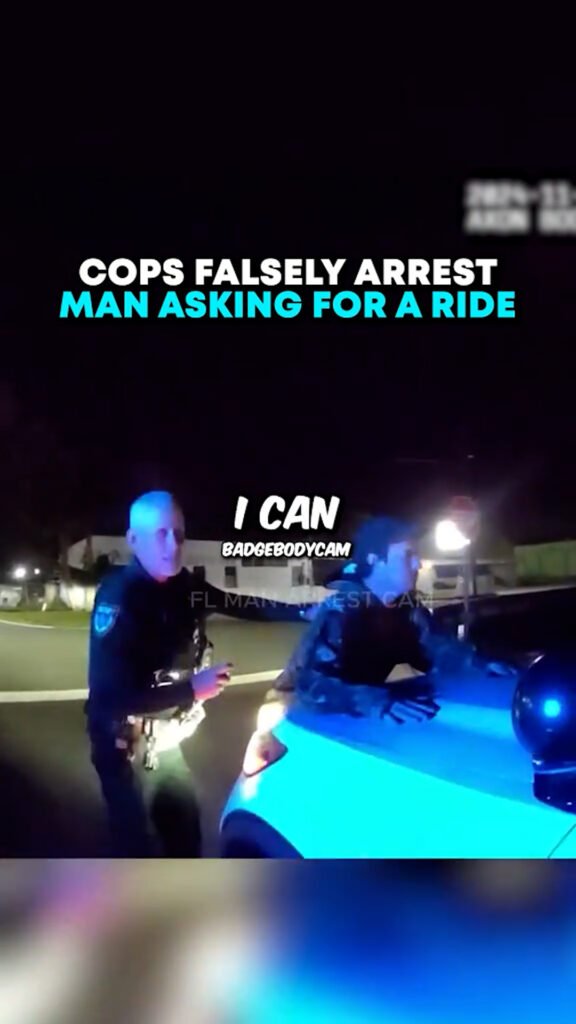
A simple plea for help turned into a night behind bars.
It was late evening in a quiet Florida suburb when 32-year-old David Monroe approached two police officers parked outside a convenience store. His car had broken down nearby, and he simply wanted a ride home. What followed next, captured on bodycam footage, would spiral into one of the most controversial arrests of the year.
David appeared calm and polite, explaining his situation as the officers listened. But moments later, the tone changed. One officer asked for his ID, and when David questioned why, things escalated fast.
“I’m just asking for a ride. I didn’t do anything wrong,” David said, visibly confused.
“Put your hands behind your back,” the officer replied.
Within seconds, David was handcuffed, pressed against the hood of the patrol car — still pleading that he hadn’t committed a crime.
What Happened Next
According to the police report, officers claimed David was acting “suspiciously” and “refused to identify himself.” But the footage tells another story. David handed over his license willingly and remained compliant throughout the encounter.
The officers detained him “for investigation,” searching his pockets and even running his name for warrants — none were found. Yet, instead of releasing him immediately, they kept him in cuffs for over fifteen minutes, accusing him of “interfering with police duties.”
Eventually, they admitted there was no probable cause and let him go. No charges were filed. But by then, the video of the incident — uploaded by a bystander — had already gone viral.
Community Reaction
The footage sparked outrage online and in the local community. Commenters described the arrest as a “clear abuse of authority” and “a lesson in how quickly an innocent person can be treated like a suspect.”
“He didn’t yell, he didn’t resist, he didn’t run,” one Facebook user wrote. “He literally asked for a ride.”
Civil rights advocates have since taken interest in the case, pointing to it as another example of misuse of power and lack of de-escalation training among officers.
Even law enforcement officials outside the department criticized the behavior seen in the video. One retired sergeant told reporters,
“It’s not illegal to ask a cop for help. The badge isn’t a license to humiliate people.”
Police Department Response
A spokesperson for the Palm Valley Police Department released a short statement acknowledging the incident and confirming that an internal investigation is underway. The department insists that the officers “acted according to their perception of a potential threat,” but many find that explanation weak.
The department’s chief has since promised to review all public interaction policies, stating:
“We want our community to feel safe approaching our officers — not afraid.”
David Speaks Out
In an interview days after the incident, David said the experience shook his faith in law enforcement.
“I grew up respecting police,” he said. “But that night, it felt like I was treated as guilty before I even opened my mouth.”
He’s now considering legal action, citing wrongful detention and emotional distress.
“I didn’t want money or attention,” he added. “I just wanted a ride home.”
A Growing Pattern
Experts say cases like this aren’t isolated. Across the country, bodycam footage continues to expose instances of misjudged detentions, where minor encounters spiral into arrests over nothing more than ego, miscommunication, or assumption.
Civil rights attorneys emphasize that these events highlight the urgent need for empathy-based policing.
“Authority should never replace humanity,” one lawyer said.
The video of David’s arrest has been viewed over 15 million times across multiple social platforms — and the public’s reaction remains divided. Some defend the officers’ caution, while others argue this is exactly why bodycam transparency is so critical.
“It’s not just about what they did,” said one commenter, “it’s about how easily it could happen to any of us.”

