Air travel is built on routine. Passengers board, engines hum to life, and within minutes, the aircraft lifts off toward its destination. Most of the time, these steps pass without a second thought.
But sometimes, routine breaks.
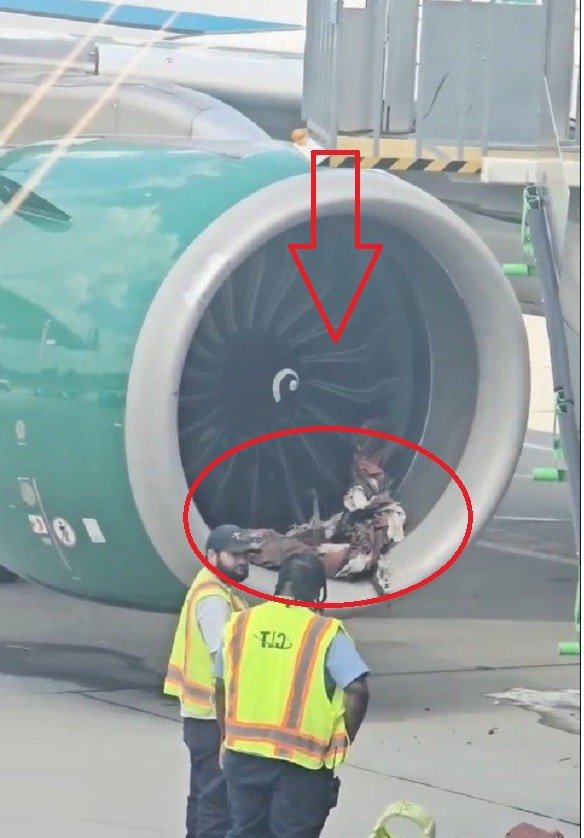
On what should have been an ordinary departure at Charlotte Douglas International Airport, something went wrong—suddenly and visibly—turning a standard takeoff into a moment that left passengers shaken and observers stunned.
The Moment Everything Changed
The aircraft, a Frontier Airlines Airbus A320, had begun its departure process like any other flight. There was no warning, no sign of trouble as it moved along the runway.
Then, without much notice, the engine experienced a serious malfunction.
Witnesses described a loud, unsettling noise—far from the steady hum passengers expect during takeoff. Instead of smooth acceleration, there was disruption. Something inside the engine had failed, breaking apart in a way that immediately drew attention.
For those onboard, the shift was instant.
What had been a routine moment quickly turned into uncertainty.
Inside the Cabin
Passengers rely heavily on the assumption that everything is under control. When that sense of control is interrupted, even briefly, it changes the atmosphere.
In situations like this, sound becomes the first signal. A loud mechanical disruption is enough to trigger concern, even before any official announcement is made.
While exact reactions vary, it’s common for passengers to move from calm to alert within seconds—watching, listening, waiting for clarity.
Moments like these stretch.
Even a few seconds can feel much longer when something unexpected happens mid-takeoff.
A Controlled Response
Despite the severity of the mechanical issue, the outcome did not escalate into disaster.
The crew followed emergency procedures, managing the situation with precision. The aircraft was prevented from continuing a potentially dangerous takeoff, and steps were taken to ensure the safety of everyone onboard.
This is where training becomes visible.
Pilots and crew prepare extensively for scenarios like this—rare, but critical. Their ability to respond quickly often determines whether a situation remains contained or becomes something far worse.
In this case, the response helped stabilize what could have been a far more serious incident.
Why Engine Failures Feel So Alarming
Aircraft engines are designed with multiple safety layers. Failures are rare, and when they do occur, systems are built to contain damage and prevent escalation.
Still, the visual and auditory impact of an engine malfunction is hard to ignore.
From the outside, it can appear dramatic—metal fragments, unusual noise, visible disruption. From the inside, passengers experience it primarily through sound and movement.
That contrast—between controlled systems and perceived chaos—is what makes these events feel so intense.
The Role of Redundancy in Aviation
Modern aircraft are built with redundancy in mind.
Even if one engine fails, planes like the Airbus A320 are designed to continue operating safely on the remaining engine. This is a fundamental principle in aviation safety.
However, during takeoff—one of the most sensitive phases of flight—any malfunction carries additional weight. Decisions must be made quickly:
- Continue the takeoff
- Abort and stop safely
- Assess potential damage
These decisions are guided by strict protocols, not guesswork.
The Passenger Perspective
For passengers, the technical explanation often comes later.
In the moment, what matters is sensation:
- The sudden change in sound
- The shift in movement
- The visible reaction of crew members
These cues shape how the situation is perceived.
Even when everything is handled correctly, the experience can leave a lasting impression—less because of what actually happened, and more because of how it felt.
A Reminder of How Thin the Margin Can Feel
Events like this highlight a subtle reality about air travel.
On one hand, it is one of the safest forms of transportation, built on layers of engineering, testing, and regulation. On the other, when something goes wrong—even briefly—it reminds passengers how much trust is placed in those systems.
That contrast is what makes incidents like this resonate.
They are rare, but when they happen, they reveal the complexity behind what usually feels simple.
What Happens After Incidents Like This
After a mechanical failure, investigations typically follow.
Engine components are examined, maintenance records reviewed, and the sequence of events reconstructed. The goal is not just to understand what failed, but why—and how to prevent it in the future.
This process is a core part of aviation safety culture.
Each incident, even one that ends without injury, becomes a data point for improvement.
A Moment That Didn’t Become a Disaster
In the end, what stands out about this event is not just the failure itself, but the outcome.
A potentially dangerous situation was contained. Passengers remained safe. The aircraft did not continue into a more critical phase with compromised systems.
What began as a moment of fear on the runway ended as a controlled emergency.
And while those onboard may remember the sound, the tension, and the uncertainty, the broader story is one of systems working as intended—even when something goes wrong.