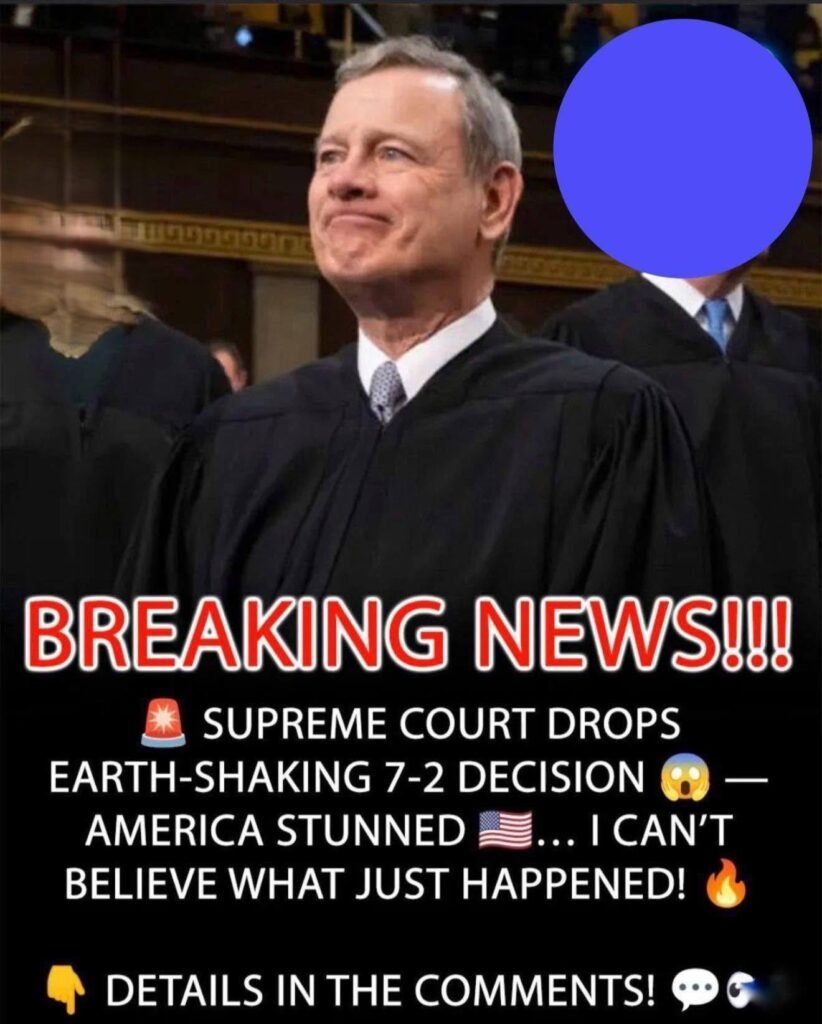
A 7–2 ruling from the U.S. Supreme Court doesn’t happen quietly.
When such a decisive split emerges, it usually signals more than just a legal disagreement—it reflects a moment where the Court is drawing a clear line. That’s exactly what happened in a recent decision that has quickly sparked debate across political, legal, and public circles.
But beyond the headlines and reactions, the real question is simple: what did the Court actually decide—and why does it matter?
The Core of the Decision
At the center of the case was a controversial government action tied to immigration enforcement. Specifically, the administration attempted to use an old wartime law—the Alien Enemies Act—to accelerate deportations of certain individuals.
The approach raised immediate legal concerns.
In a 7–2 decision, the Supreme Court stepped in and blocked those removals, at least temporarily, while the case continues through the courts.
The justices did not rule on every aspect of the policy. Instead, they focused on a fundamental issue: whether the individuals affected were being given a fair opportunity to challenge their removal.
And on that point, the majority was clear—the process being used did not meet basic legal standards.
Why Due Process Became the Key Issue
The concept at the heart of the ruling is due process.
In simple terms, due process means that the government cannot take serious action against someone—like deportation—without giving them a fair chance to respond. That includes proper notice and the ability to challenge the decision.
According to the Court, the system in place failed that test.
Reports indicate that some individuals were given as little as 24 hours’ notice before removal, without clear information on how to defend themselves.
For the majority of justices, that wasn’t enough.
Even in cases involving national security or immigration enforcement, the Court signaled that basic legal protections still apply.
A Rarely Used Law at the Center
Part of what made this case unusual is the law involved.
The Alien Enemies Act dates back to 1798—a time when the United States was facing very different kinds of threats. It allows the government to detain or remove individuals from countries considered hostile during wartime.
Using that law in a modern immigration context raised complex legal questions.
Was the situation comparable to a wartime threat?
Could the government bypass normal legal procedures?
And how much flexibility does the executive branch really have?
The Supreme Court didn’t answer all of those questions directly. Instead, it sent parts of the case back to a lower court for further review.
But its message on due process was unmistakable.
What the 7–2 Split Tells Us
The margin of the decision is just as important as the outcome.
A 7–2 ruling suggests broad agreement across the Court, even among justices who often disagree on politically sensitive issues. Only two justices dissented, indicating that the majority saw the legal problem as relatively clear.
That level of consensus adds weight to the ruling.
It signals that, at least in this instance, the Court was less divided along ideological lines and more focused on a shared interpretation of constitutional protections.
Immediate Impact — And What Comes Next
In practical terms, the decision pauses the government’s ability to carry out these specific deportations under the challenged process.
It doesn’t permanently block the policy.
Instead, it forces a reassessment. Lower courts will now examine whether the use of the law itself is valid and what kind of procedures must be followed moving forward.
That means the case is far from over.
What happens next could shape how immigration enforcement is handled in similar situations—and how far executive power can extend when older laws are applied to modern challenges.
Why This Case Matters Beyond Immigration
While the case centers on deportation, its implications go further.
At its core, the ruling reinforces a broader principle: even in urgent or politically charged situations, legal safeguards cannot be ignored.
The decision touches on several key themes:
- The limits of executive authority
- The role of courts in checking government actions
- The continued importance of constitutional protections
In that sense, it’s not just about one policy or one group of people. It’s about how the legal system balances power and rights in complex situations.
A Reminder of the Court’s Role
Supreme Court decisions often carry symbolic weight, but this one also highlights something more practical.
The Court acts as a checkpoint.
When questions arise about whether government actions go too far—or move too quickly—it steps in to interpret the law and set boundaries. This case is a clear example of that function in action.
A Decision That Leaves Open Questions
Despite the strong majority, the ruling doesn’t resolve everything.
Key issues remain unsettled, including whether the law itself can be used in this way and what standards will ultimately apply.
Those answers will likely emerge in future rulings.
For now, the decision stands as a pause—and a signal. It shows that even in moments of urgency, the legal process cannot be shortened without consequences.
The Bigger Picture
Legal decisions rarely exist in isolation.
This one arrives at a time when questions about immigration, executive authority, and constitutional limits are already part of broader public debate. The Court’s intervention adds another layer to that conversation.
It doesn’t settle the debate—but it shapes it.
And in doing so, it reminds both policymakers and the public that the balance between power and protection remains one of the most closely guarded aspects of the legal system.